1. What Was Published
An imec researcher, Utkarsh Jain, has published an analytical treatment of bond front propagation in direct bonding, titled "Bond Front Velocity in Lubrication-Mediated Bonding of Flexible Substrates." The paper appeared in Proceedings of the Royal Society A (vol. 482, no. 2338, article 20260071, doi 10.1098/rspa.2026.0071) and was added to Semiconductor Engineering's technical paper library on August 7, 2026, appearing in the site's August 10 technical paper roundup.
The paper's framing is explicit about why this matters now: bonding and assembly processes "have started to take the centre-stage in semiconductor manufacturing as they enable three-dimensional (3D) stacking and heterogeneous integration for novel interconnect architectures of integrated circuits."
2. What a Bond Wave Is and Why Its Speed Matters
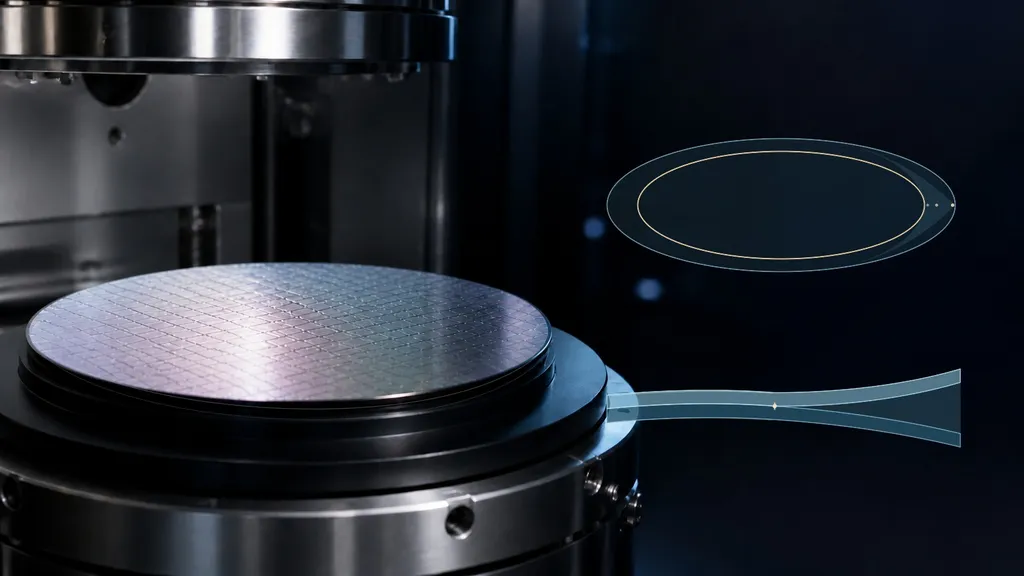
In direct (fusion) wafer-to-wafer bonding, the two wafers are not pressed together all at once. Contact is initiated at a point, and a bond front — the bond wave, or bondwave — sweeps outward across the wafer, closing the remaining gap as it travels. Everything the process engineer cares about is decided during that sweep: whether air or particles get trapped as voids, and how much in-plane distortion the wafers accumulate as they deform to meet each other.
That distortion is the constraint that governs how fine an interconnect pitch a wafer-to-wafer flow can hold. As hybrid bonding pitches tighten, run-out and local distortion introduced during bond front propagation eat directly into the overlay budget. A predictive model of how fast the front moves — and where it speeds up — is therefore a process-control asset, not just a fluid-mechanics curiosity.
3. Inside the Lubrication–Elasticity Model
The paper builds a lubrication–elasticity model that stays within continuum limits and deliberately excludes adhesion mechanisms, isolating the near-field dynamics of the process. Two physical ingredients govern the result: lubrication flow of the gas in the closing gap ahead of the front, and linear elasticity in the substrates themselves.
Under those assumptions, the unbonded portion of the substrates takes a power-law shape as a function of distance from the bond front. From that geometry the author derives what the paper describes as an entirely self-consistent formulation for the bond front velocity. The key move is a re-parameterization of the problem in terms of a "high viscous dissipation region" sitting ahead of the bond front, which travels along with the adhesion front — the progression of the front is set by the balance of adhesion and dissipation forces.
4. The Acceleration Problem at the Wafer Edge
The practically interesting consequence is that this formulation naturally produces acceleration. As the unbonded region shrinks — for example, as the bond front approaches the edge of a finite substrate — the velocity is not constant but increases.
That is a meaningful result for anyone who has looked at void and distortion maps and found that the wafer edge behaves differently from the center. A model that predicts edge acceleration from first principles gives a physical basis for why edge-region defectivity and distortion signatures differ, rather than treating them as an empirical quirk to be tuned out.
The paper also proposes unifying velocity and length scales, incorporating a lateral adhesion front length scale that captures velocity variations in the limit of vanishing viscous dissipation — an attempt to bridge continuum and molecular scales in one framework. The stated aim is scalable insight for "better understanding and process control in applications with wafer and die bonding."
5. What the Model Does Not Cover
This is an analytical model, not an equipment announcement or an experimental yield result, and the paper is clear about its scope. Adhesion mechanisms are excluded by construction; the treatment stays within continuum limits and addresses flexible substrates under lubrication-mediated bonding.
What it does not address is the chemistry that sets the adhesion energy in the first place — the plasma activation, the surface termination, the dielectric film properties. Those remain the levers a process engineer actually turns. The model describes how the front moves given those conditions; it does not tell you how to choose them.
6. NineScrolls Niche Angle
The reason this paper is relevant to plasma processing and thin-film deposition is that the bond front's behavior is downstream of surface preparation. The adhesion side of the adhesion-versus-dissipation balance is set by plasma activation of the bonding dielectric — the step that converts an oxide surface to a hydrophilic, hydroxyl-terminated state — and by the quality, uniformity, and roughness of the PECVD or ALD film beneath it, whether SiO₂ or SiCN. A model of front velocity is only actionable if the deposition and activation steps that feed it are controlled and repeatable.
The geometry side matters just as much. Substrate flatness, total thickness variation, and wafer bow determine the elastic response that this model treats as linear elasticity in the substrates — which is exactly why carrier and bonding-layer choices propagate into distortion. Readers working through these trade-offs should start with our comparison of wafer-to-wafer versus die-to-wafer bonding, which covers where W2W's throughput advantage runs into its alignment and distortion ceiling. For the interconnect context driving this work, see hybrid bonding versus micro-bump interconnect, and for the carrier-side constraints that shape substrate deformation during handling, our guide to temporary wafer bonding and debonding.
Finally, voids and distortion introduced at the bond front do not stay at the bond interface — they show up later as delamination and stress-driven failures in the stack, which we cover in 3D packaging reliability. For the equipment supply chain, the message is consistent with what we have been tracking all year: the value in 3D integration is migrating toward surface preparation, conformal dielectric deposition, and plasma activation control — the front end of the bonding flow, not the bonder alone.
7. Sources
- Semiconductor Engineering — Mathematical Model Explains Bondwave Velocity and its Acceleration in Direct Wafer-Wafer Bonding (imec)
- Jain, Utkarsh. "Bond Front Velocity in Lubrication-Mediated Bonding of Flexible Substrates." Proceedings of the Royal Society A 482, no. 2338 (2026): 20260071
- Semiconductor Engineering — Chip Industry Technical Paper Roundup: Aug. 10
- Semiconductor Engineering — TSV Complexity Leads To Manufacturing Bottleneck