Applications
Cryogenic probe stations for low-temperature research
Ambient probing covers most electrical characterization. But if your devices only show their physics cold — superconducting electronics, quantum transport, 2D material devices — the temperature stage becomes the defining and most expensive part of the system.
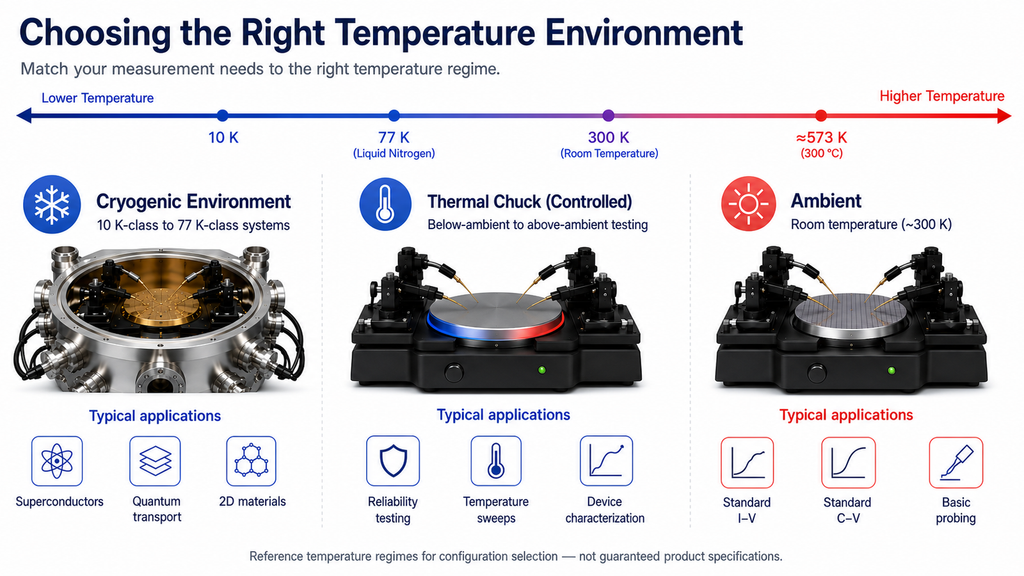
- Ambient
- Room-temperature probing
- Thermal chuck
- Heated / cooled chuck
- Cryogenic vacuum
- LN₂ / LHe, inside vacuum
Decision worksheet
Which environment does your measurement need?
Start with the question your experiment must answer. The environment sets what your device can do — and what your data can prove.
Ambient
Ask yourself
Do the device physics you care about appear at room temperature?
Thermal chuck
Ask yourself
Do you need to sweep temperature to reveal or control behavior?
Cryogenic vacuum
Ask yourself
Do the effects you need to study only show up at cryogenic temperatures?
Why vacuum matters
Below the dew point, any surface in open air ices over. Cryogenic stations therefore probe inside an evacuated chamber: the vacuum prevents condensation, improves thermal stability, and reduces convective heat load on the chuck. Optical windows and magnetic-field options extend the same platform to spintronics and optoelectronic studies.
Bring these four answers to your quote
- Base temperature under real probing load — not just the bare-chuck figure.
- Cooldown time and liquid-cryogen consumption per run, which set your daily cadence.
- Probe-arm thermal anchoring, so the tips do not heat your device.
- Optical access, magnet options, and RF feedthroughs if your roadmap needs them.
The three temperature regimes
Probing setups fall into three tiers. An ambient station measures at room temperature. A thermal-chuck station adds a heated or cooled chuck for reliability and temperature-dependent I–V work. A cryogenic-vacuum station encloses the sample in vacuum and cools it with liquid nitrogen or liquid helium / closed-cycle architectures — the regime where superconductivity and quantum transport phenomena become measurable. Exact usable limits depend on the selected configuration.
Sourced product pathways
Where to go next
SEMISHARE product lines
NineScrolls resources
Planning a low-temperature setup?
Tell us your target temperature, sample size, and signal type — we will confirm a configuration with the manufacturer and quote with US delivery and support.