
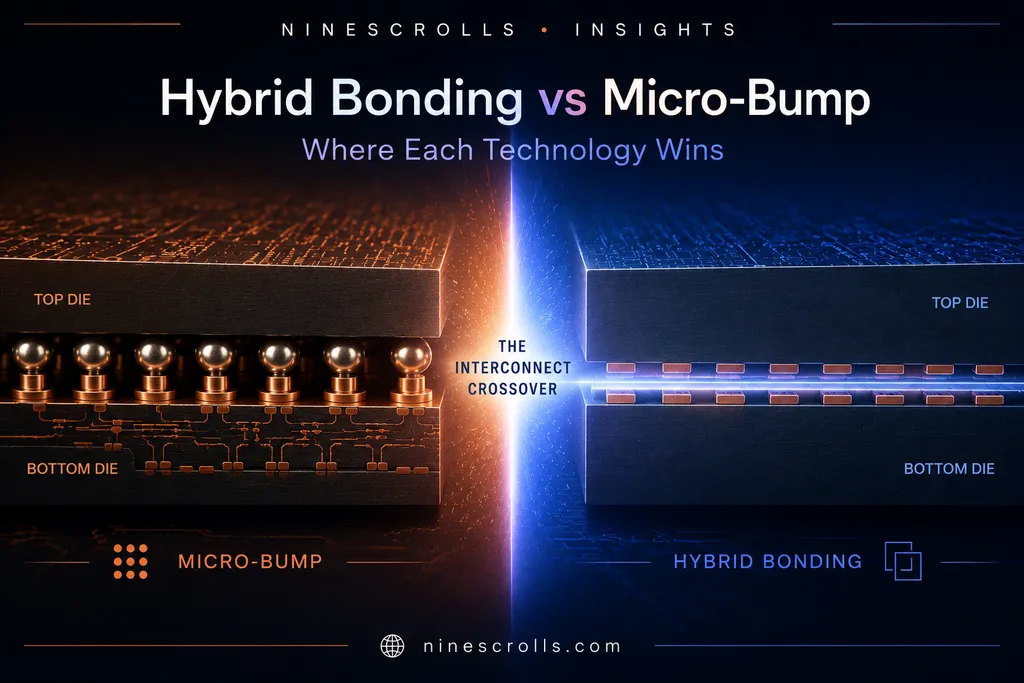
The interconnect crossover: where micro-bumps stop scaling and hybrid bonding takes over. Every advanced package faces the same interconnect decision, and this guide answers one question only — when do you switch? It deliberately does not cover how the bonding itself works: for the mechanism and why hybrid bonding won the post-bump era, see our Wafer Bonding Technologies Guide; for the surface chemistry that makes a Cu-Cu bond succeed, see Surface Preparation for Cu-Cu Hybrid Bonding; and for diagnosing bonds that have already failed, see Hybrid Bonding Failure Analysis. What remains — the crossover itself — is the decision this page exists to settle.
1. The Quick Answer: Micro-Bump or Hybrid Bonding?
If you arrived with a pitch number in hand, here is the answer up front. The decision space divides into three zones:
- Above roughly 20 µm pitch — fine-pitch micro-bump / Cu-pillar wins. The process is mature, the supply chain is deep, cost per connection is low, and assembly throughput is high. At these pitches there is no technical case for paying hybrid bonding's process burden.
- Roughly 10–20 µm — the transition zone. Both technologies are viable here, and the right answer depends on architecture and economics: how many connections you need, what bandwidth and power budget the design demands, what volume you will run, and what process capability you can access. This is where most real selection decisions actually live.
- Below roughly 10 µm — hybrid bonding is effectively the only option. The connection density and short interconnect lengths that designs at this pitch require are simply not reachable with solder-based joints.
Note the "roughly" in every boundary — these are zones, not hard thresholds. The rest of this article explains why the crossover happens where it does, and how to make the call when your design lands inside the transition zone.
2. Why Not Just Keep Shrinking Micro-Bumps?
The instinctive objection is fair: micro-bumps have been shrinking for decades — why stop now? They are not a dead end that appeared overnight. They are the latest rung of a continuous interconnect evolution that has been climbing the same ladder since flip chip was introduced. C4 solder balls connected die to substrate at pitches of hundreds of micrometers. Copper pillar capped with solder took that down to roughly 40–100 µm. Fine-pitch micro-bumps pushed it further still, to roughly 10–40 µm. Each rung did the same three things: it shrank the pitch, raised the connection density, and shortened the interconnect.
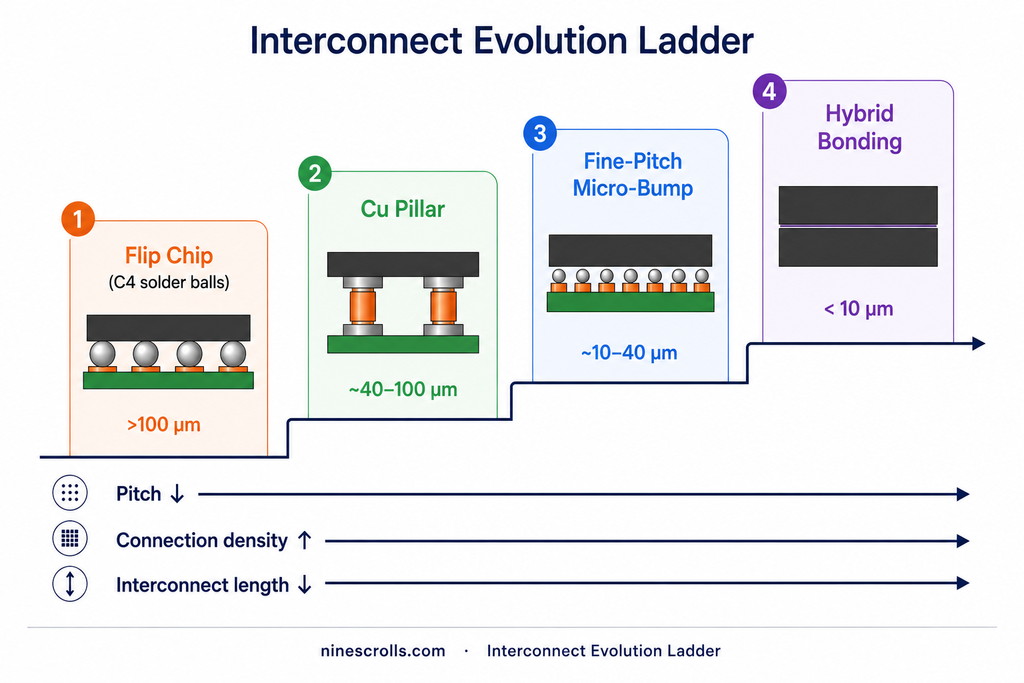
Seen this way, the natural question writes itself: why not climb one more rung — shrink the micro-bump again and skip the disruption of a new bonding approach entirely? The answer, and the reason the crossover exists at all, is that below roughly 10–20 µm the obstacle is no longer manufacturing precision but the physics of solder itself. That is where the next section begins.
3. The Micro-Bump Scaling Wall
The wall is not a single failure mode but five of them arriving at once, each tied to the same root cause: solder is a melted, reflowed material, and below roughly 10–20 µm pitch the joint becomes too small for melted metal to behave predictably.
Bump collapse and bridging. As bump volumes shrink, solder-volume variation becomes a larger fraction of the total, so some joints collapse short while neighbors stand tall — and molten solder that spreads even slightly bridges to its neighbor. The narrowing standoff also makes underfill harder to flow, so voiding worsens just as the joints grow more fragile.
Intermetallic compounds take over the joint. Intermetallic compounds (IMCs) form wherever solder meets the copper or nickel below, and the IMC layers stay roughly the same thickness as the joint shrinks — so their share of the joint grows, approaching the whole joint in the smallest micro-bumps. Because IMCs are brittle and electrically inferior to bulk solder, the scaled joint is weaker and ages worse.
Current crowding and electromigration. A smaller joint cross-section means higher current density — multiplied further by crowding at the joint's entry corner — and electromigration lifetime falls (interconnect fatigue as a system-level reliability mechanism is covered in Reliability Challenges in High-Density 3D Packaging) steeply with current density. A comfortable margin at 40 µm pitch can collapse to an unacceptable one at 10 µm.
Parasitics. A micro-bump is a pillar-plus-solder stack tens of micrometers tall, and each joint adds resistance, inductance, and capacitance. At the I/O counts that HBM-class stacks and die-to-die fabrics demand, the aggregate RC penalty consumes bandwidth and power budgets the architecture cannot spare.
Economics stop cooperating. Historically, each pitch shrink lowered cost per connection. Below roughly 20 µm the trend inverts: placement tolerances tighten, bonder throughput drops, yield loss rises, and cost per I/O climbs rather than falls. The technology stops paying for itself.
4. What Hybrid Bonding Changes
Hybrid bonding's answer to the scaling wall is blunt: remove the solder entirely. The joint that collapsed, bridged, embrittled, and electromigrated is replaced by a direct Cu-Cu metallurgical connection embedded in a bonded dielectric plane — copper pad meets copper pad, dielectric meets dielectric, and the interface becomes a continuous bonded surface rather than an array of discrete melted joints. How that bond is actually formed is its own subject, covered in our Wafer Bonding Technologies Guide; what matters for the selection decision is what the change does to the interconnect.
Three deltas follow directly. First, pitch takes a step change rather than an increment: where micro-bumps strain below roughly 10 µm, hybrid bonding pads sit comfortably at low single-digit micrometer pitches today, with sub-micrometer demonstrations pointing the way down. That is a connection-density gain of one to two orders of magnitude, not a generational bump. Second, the interconnect length effectively vanishes. The tens of micrometers of pillar-plus-bump stack between die collapse to essentially zero, taking the joint's resistance, inductance, and capacitance with it — signals cross between die with near on-chip parasitics, and the solid metal-and-dielectric interface conducts heat far better than an underfilled bump gap ever could. Third, those two together are what make HBM-class — and beyond — bandwidth density reachable at a power-per-bit that bumps cannot match.
The catch, and the reason the crossover is a genuine decision rather than a foregone conclusion, is what the switch costs: hybrid bonding replaces an assembly-grade process with a fab-grade one, with everything that implies for cleanliness, capital, and process control. That trade is the subject of the next section.
5. The Crossover Region
It is tempting to read the industry roadmap as a single number: hybrid bonding takes over at pitch X, and the only question is when your design crosses it. That reading is wrong. The crossover is a region, not a line, and where a product lands inside it depends on architecture, volume, and economics — not pitch alone. The three zones from Section 1 hold: above roughly 20 µm, micro-bump wins by default; below roughly 10 µm, hybrid bonding is effectively forced. But between those boundaries lies the genuinely contested region, and inside it the deciding variables are not on the roadmap at all.
Yield economics is the real gatekeeper. The deepest difference between the two technologies is not electrical or thermal — it is how each one handles imperfection. Micro-bump assembly tolerates it. Dies can be tested before assembly, so known-good-die screening filters defects out of the stack before they cost anything. A marginal joint can often be reworked. And when a joint does fail, the loss is bounded: one package. Hybrid bonding offers none of these escapes. The bond is permanent — there is no rework path, so a single bond defect writes off the entire stack, and in wafer-to-wafer configurations a defect writes off die from both wafers at once, including known-good die that happened to land opposite a bad one (for the full format-selection framework, see Wafer-to-Wafer vs Die-to-Wafer). The selection question therefore reduces to three inputs: how high is your die yield, how much test coverage can you achieve before bonding, and how much is the stack worth? High-value stacks — HBM, logic-on-logic for flagship compute — can absorb the no-rework risk because each unit carries enough margin to pay for the losses. Cost-sensitive products cannot: for them, the ability to test, rework, and bound the cost of failure is worth more than any density gain, and micro-bump wins even at pitches where hybrid bonding is technically comfortable.
Thermal is a second crossover, and it can arrive first. A micro-bumped interface places solder joints and underfill between stacked dies — a composite layer that conducts heat poorly and becomes the thermal bottleneck of the stack. Hybrid bonding replaces that layer with continuous copper and dielectric, and the direct Cu-Cu connections embedded in a solid dielectric plane move heat between dies far more effectively. As power density in stacked architectures climbs — AI accelerators stacking logic on logic are the sharpest case — the thermal budget can force the switch on its own. A design may sit comfortably above the pitch wall and still require hybrid bonding simply because the stack cannot otherwise get its heat out.
Cost and throughput cross over too — but later than density. Micro-bump assembly runs on assembly-grade infrastructure: mass reflow processes joints in batch, the supply chain is mature and multi-sourced, and units per hour are high. Hybrid bonding demands fab-grade cleanliness, surface planarity, and process control, and its per-stack processing is slower and far more capital-intensive. When the design needs only modest connection density, that cost gap is decisive — there is no reason to pay fab economics for a job assembly economics can do. But the comparison inverts as density requirements rise. The right metric is not cost per package; it is cost per I/O. A hybrid-bonded interface delivering hundreds of thousands to millions of connections amortizes the fab-grade process across every one of them, and at high enough density the expensive process becomes the cheap one per connection — while the “cheap” micro-bump process, pushed past its comfort zone, bleeds yield and throughput until its cost per I/O climbs above the technology it was supposed to undercut.
All of which compresses into a single principle:
Hybrid bonding is not adopted when it becomes possible. It is adopted when density requirements outweigh manufacturing economics.
Possibility arrived years before the major adopters moved. What moved them was the moment their architectures demanded more connections per square millimeter than solder could deliver at an economics they could survive. That framing also yields a usable decision procedure — four questions, asked in order:
- Density requirement — does the architecture need more connections per square millimeter than solder physics allows? If yes, the decision is already made, and nothing downstream can reverse it.
- Yield economics — can you test before bonding, and can the product absorb a no-rework process where one defect costs the whole stack?
- Cost structure — does your connection count amortize fab-grade processing, or does assembly-grade still win on cost-per-I/O at the density you actually need?
- Throughput constraint — does your volume demand mass-reflow units per hour, or does value-per-package justify slower, costlier bonding?
Inside the transition zone, walk the four steps in order. The first one that returns a decisive answer settles the selection — the questions below it no longer matter.
6. The Interconnect Selection Framework
Everything Section 5 argued compresses into a single map.
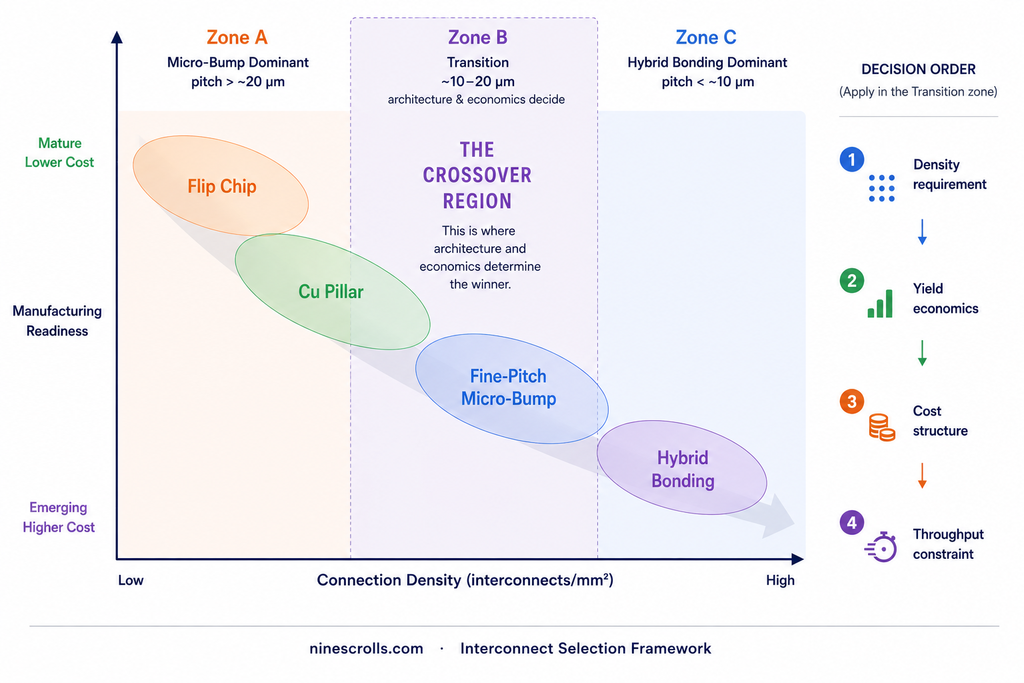
Locate your design's required connection density on the x-axis first. Technologies that cannot reach that density are eliminated outright; among the remaining candidates, manufacturing maturity and economics determine the practical choice. The zone you land in gives the default winner: in the micro-bump-dominant zone (above roughly 20 µm pitch), assembly-grade economics win without argument; in the hybrid-bonding-dominant zone (below roughly 10 µm), density forces the choice regardless of cost. Only inside the transition zone does the map stop answering — there, apply the four-step decision order from Section 5 in sequence: density requirement, yield economics, cost structure, throughput constraint. The first decisive answer settles it. The boundaries are bands, not lines — they shift with design rules, process maturity, and volume.
7. Where Each Interconnect Is Winning Today
High-Bandwidth Memory (HBM)
HBM is the textbook resident of the transition zone. Current production generations still ship on fine-pitch micro-bumps: the pitch sits where solder remains viable, the supply chain is deep, and known-good-die screening keeps yield economics on micro-bump's side. But the roadmap squeezes from two directions at once. The march toward 16-Hi stacks puts more dies in the same package height, forcing thinner dies and finer pitches toward the scaling wall of Section 3 — and every added die raises the bandwidth and thermal load the bumped interface must carry, the two pressures Section 5 identified as forcing the switch early. That is why successive HBM roadmaps place hybrid bonding in their tallest stacks. For the full thermal and materials picture, see our 16-Hi HBM deep dive.
Logic-on-Logic Chiplets
Flagship compute crossed first, and the framework predicts exactly why. 3D-stacked cache and SoIC-class logic-on-logic products need vertical connection densities that solder physics cannot deliver — step one of the decision order returns a decisive answer, and the questions below it never get asked. Just as important, these packages are best positioned to absorb hybrid bonding's no-rework risk: each unit is a flagship processor carrying enough margin to pay for stack losses, and pre-bond test coverage on logic dies is among the industry's best. So logic-on-logic stacking became hybrid bonding's marquee application even while most of the packaging market stays comfortably on bumps — a hard density requirement and high value-per-package, aligned in one product. For how the bonding itself works, see the Wafer Bonding Technologies Guide.
CMOS Image Sensors (CIS)
Image sensors were hybrid bonding's first mass-production home, years before compute. The reason is pure density: a stacked sensor wants an electrical connection at or near every pixel, and pixel-level pitches sit far below anything a solder joint can reach — micro-bump was never a candidate. The economics lined up early too: sensors bond wafer-to-wafer in enormous, uniform volumes, and mature W2W flows reached yields that made the no-rework risk acceptable long before logic could follow. CIS therefore shows the framework's forced-choice zone running in production at scale, not as a roadmap promise. One lesson from this earliest adopter carries to every application after it: at these densities, surface quality decides yield. That subject has its own page — see Surface Preparation for Cu-Cu Hybrid Bonding.
8. Key Takeaways
- Three zones. Above roughly 20 µm pitch, micro-bump wins by default; below roughly 10 µm, hybrid bonding is effectively the only option; the 10–20 µm band is the contested transition zone.
- The principle. Adoption is not triggered by feasibility — it happens when density requirements outweigh manufacturing economics.
- The other vertical decision. The interconnect between dies is half the story; the via that carries signals through the silicon has its own timing and design rules — see Through-Silicon Vias (TSV).
- The decision order. Ask in sequence: density requirement, yield economics, cost structure, throughput constraint.
- Thermal can force the switch early — even above the pitch wall, if the stack cannot get its heat out through a bumped interface.
- Inside the transition zone, the first decisive answer wins — the questions below it no longer matter.
Frequently Asked Questions
At what pitch does hybrid bonding replace micro-bumps?
There is no single number. Above roughly 20 µm pitch, micro-bump wins by default; below roughly 10 µm, hybrid bonding is effectively forced; in the 10–20 µm band, both are viable and the decision order settles the call. The boundaries shift with design rules and process maturity — treat them as zones, not thresholds.
Is hybrid bonding more expensive than micro-bump?
Per package at modest connection counts, yes. But the right metric is cost per I/O, and it inverts at high density: hybrid bonding amortizes its cost across hundreds of thousands of connections, while micro-bump pushed past its comfort zone bleeds yield until its cost per connection climbs higher.
Can a design use both micro-bumps and hybrid bonding?
Yes — the selection is made per interface, not per product. A package can use hybrid bonding for the die-to-die interface where density demands it, and micro-bumps or Cu-pillar at the substrate level where coarser pitch suffices. Mixed packages are the normal outcome.
Why can't micro-bumps just keep shrinking?
Because below roughly 10–20 µm pitch the obstacle is solder physics, not manufacturing precision: joints collapse and bridge, brittle intermetallics take over, electromigration risk climbs, and cost per connection starts rising instead of falling.
Related Articles
- Wafer Bonding Technologies for 3D Integration — how each bonding approach works.
- Surface Preparation for Cu-Cu Hybrid Bonding — the surface chemistry behind bond yield.
- Hybrid Bonding Failure Analysis — diagnosing bonds that failed.
- 16-Hi HBM: Thermal and Materials Challenges — the memory roadmap driving the crossover.
NineScrolls supplies plasma surface-activation and cleaning equipment used in advanced bonding flows. Evaluating an interconnect transition? Contact our team to discuss process capability.