
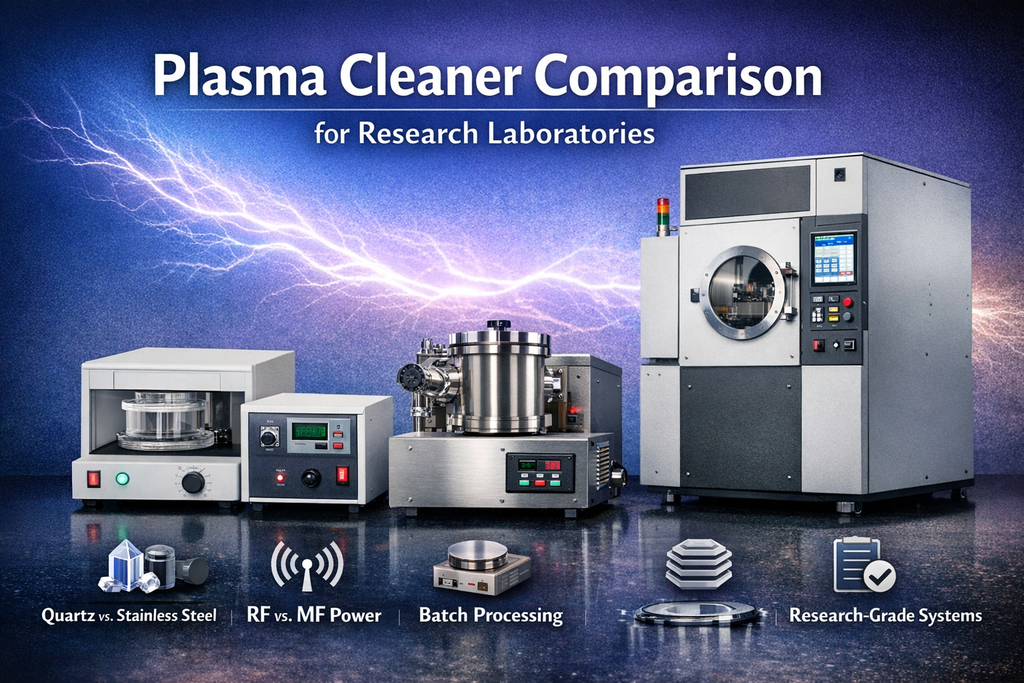
Research laboratories face a wide range of plasma cleaner options — from compact benchtop units with quartz chambers to automated batch systems with stainless steel or aluminum chambers. This guide describes how the two dominant architectures differ in construction, what each design implies for laboratory use, and which specifications to compare when narrowing a shortlist.
It is an architecture guide, not a verdict. Where a claim would require side-by-side testing to support, this article states the construction difference and stops there. Specifications cited were read from official manufacturer material on 2026-08-12 and are listed at the end. For an 18-configuration comparison table built the same way, see Benchtop Plasma Cleaner Specifications: What Four Manufacturers Publish.
The Two Dominant Chamber Architectures
The chamber material is the design choice that most other properties follow from: it constrains electrode placement, chamber geometry, and which process modes are available. Plasma cleaners for laboratory use fall into two broad categories: quartz or borosilicate glass chambers and metal chambers (stainless steel or aluminum alloy).
A note on materials, since the terms are often used interchangeably and are not equivalent. Pyrex is a Corning brand of borosilicate glass; borosilicate glass is the material class; quartz — fused silica — is a different material with a different thermal expansion coefficient and a higher service temperature. Harrick's chambers are Pyrex as standard with an optional quartz chamberH-1; Diener's Zepto and Atto chambers are borosilicate glassD-1D-2; PIE Scientific's Tergeo chambers are quartzP-1.
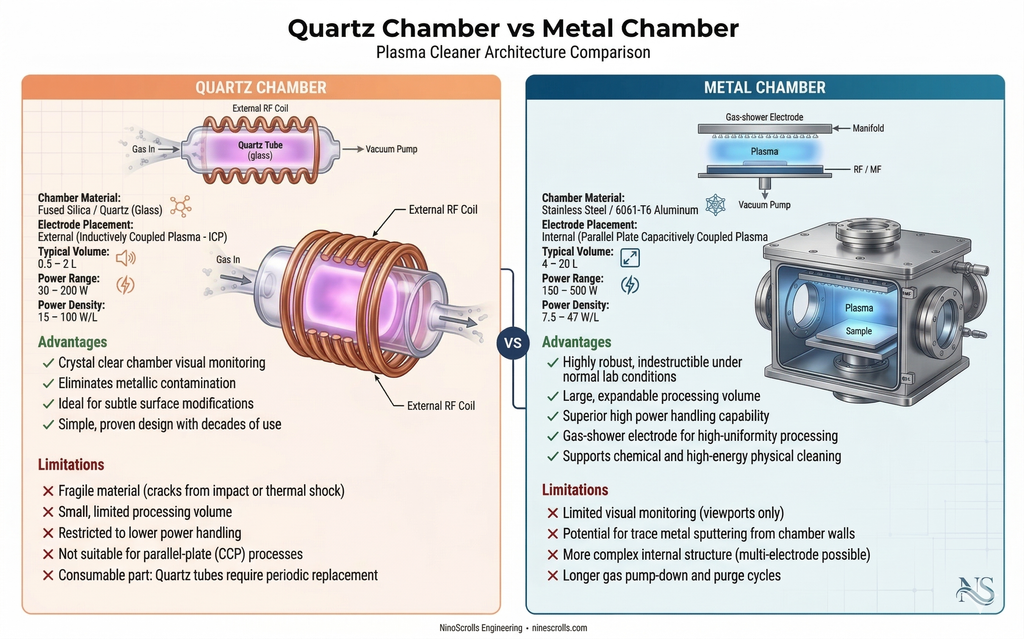
Figure 1: Quartz chamber vs metal chamber architecture — external electrode design (left) vs internal parallel-plate design (right)
Glass and Quartz-Chamber Systems
These systems — the architecture used by Harrick Plasma, Diener electronic and PIE Scientific in the configurations reviewed — use a tubular or cylindrical glass vessel as both the vacuum enclosure and the plasma containment zone. The electrodes sit outside the chamber wall: Diener describes an "electrode pair outside the vacuum chamber"D-1D-2, and PIE Scientific describes external RF electrodes and antenna designs on the Tergeo-Plus and external curved capacitively coupled electrodes on the Tergeo-ProP-2P-3.
What the construction gives you:
- Visual access to the discharge. A transparent chamber wall lets an operator see the plasma glow, which is a practical way to confirm ignition without instrumentation.
- No electrode surface in contact with the process gas. With the electrodes outside a dielectric wall, there is no biased metal surface inside the chamber for ions to sputter. Where trace metal deposition would confound a measurement, this is the structural reason to prefer the architecture.
What the construction constrains:
- Chamber diameter. The reviewed glass and quartz chambers range from 3″ (76.2 mm) on the Harrick PDC-32GH-1 and Ø 105 mm on the Diener ZeptoD-1 up to Ø 211 mm on the Diener AttoD-2 and Ø 230 mm on the PIE Tergeo-ProP-3. A cylindrical chamber takes nothing wider than its internal diameter regardless of length.
- Published power levels. Across the reviewed glass-chamber configurations, published figures run from a maximum of 18 W (Harrick PDC-32G)H-1 and 0–30 W (Diener Zepto One)D-1 to 0–300 W (Diener Atto at 13.56 MHz)D-2 and 500 W options (PIE Tergeo-Plus and Tergeo-Pro)P-2P-3. Note that these are published on different bases — maximum, adjustable range, and discrete options — so the figures are not directly comparable without their basis.
- Mechanical handling. Glass and quartz are brittle. Thermal shock and mechanical impact are handling considerations that do not apply to metal vessels. Replacement chamber cost and service requirements vary by vendor and are not published in the material reviewed — ask before purchase.
Metal-Chamber Systems (Stainless Steel / Aluminum)
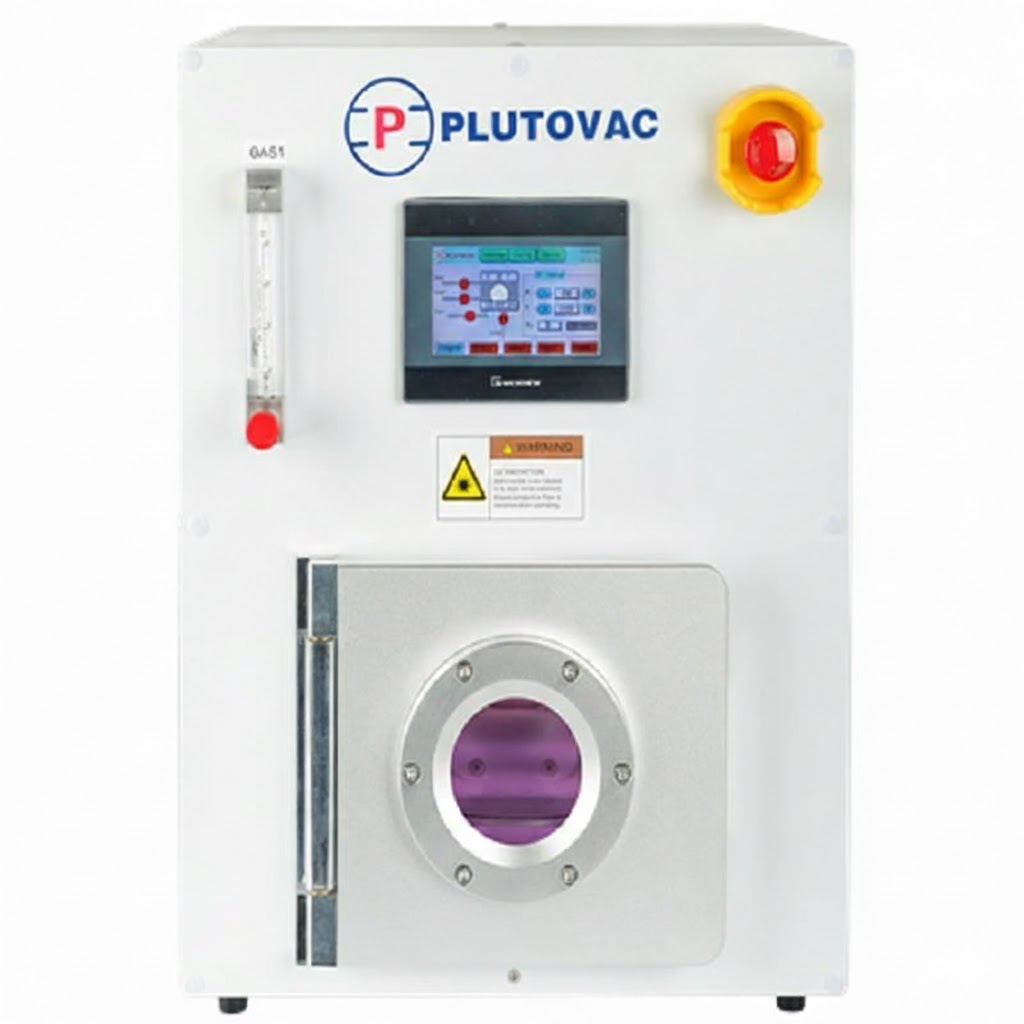
Metal-chamber plasma cleaners use a stainless steel or aluminum alloy vacuum vessel with electrodes inside the chamber. NineScrolls' PLUTO configurations publish in-chamber electrodes — a 95 × 170 mm flat plate on the PLUTO-TNS-4, a 125 × 125 mm perforated gas-shower plate on the PLUTO-MNS-5, and a 205 × 205 mm flat plate on the PLUTO-FNS-6. The architecture is not exclusive to any one manufacturer: Diener's Zepto RIE uses an aluminium chamber with an electrode inside the vacuum chamber, Ø 160 mm for a maximum 6″ waferD-1.
What the construction gives you:
- Rectangular chamber geometry becomes available. Metal fabrication is not constrained to a tube. The reviewed metal chambers include 250 × 250 × 320 mm (NineScrolls HY-20L and HY-20LRF)NS-2NS-3 and 240 × 300 × 200 mm (PLUTO-F)NS-6. For flat samples, the constraining dimension is the shortest side, which a rectangular vessel of the same volume can make larger than a cylinder can.
- An electrode surface inside the chamber. Placing a biased electrode in the process volume makes capacitively coupled configurations possible, and allows electrode geometry to be used for gas distribution — the PLUTO-M's perforated gas-shower plate delivers process gas through the electrode itselfNS-5.
What the construction constrains:
- No visual access. Process verification relies on instrument readings and on results-based validation such as contact angle measurement.
- A metal surface is exposed to the discharge. Under sputtering conditions — high power with an inert gas such as pure argon — material from an in-chamber electrode can reach the sample. Process gas selection is the usual mitigation; where metal contamination must be excluded structurally rather than procedurally, the external-electrode architecture removes the surface entirely.
RF (13.56 MHz) vs Mid-Frequency (40 kHz)
Some systems offer a choice of excitation frequency. Among the configurations reviewed, Diener publishes both a kHz and a 13.56 MHz option for the Zepto One (100 kHz or 13.56 MHz, both 0–30 W), the Zepto (40 kHz at 0–100 W or 13.56 MHz at 0–200 W) and the Atto (40 kHz at 0–200 W or 13.56 MHz at 0–300 W)D-1D-2. NineScrolls publishes RF and mid-frequency options for the HY-4L and HY-20L, each with its own power figure and priceNS-1NS-2.
Two differences are matters of record rather than performance:
- 13.56 MHz is an ISM band allocated internationally for industrial, scientific and medical use, and it is the frequency most published plasma processing literature specifies. A lab intending to reproduce a published protocol, or to have its own protocol reproduced elsewhere, has a documentation reason to match it.
- Published power figures differ between the two options on the same model. On the Diener Zepto the kHz option publishes 0–100 W against 0–200 W for 13.56 MHzD-1; on the NineScrolls HY-4L and HY-20L the mid-frequency option publishes 300 W against 150 W for RFNS-1NS-2. The direction is not consistent across manufacturers, so the figures have to be read per model.
Beyond that, differences in plasma density, uniformity or substrate charging behaviour between the two frequencies depend on chamber geometry, pressure and gas chemistry, and no published specification in the reviewed set quantifies them for these systems. Where excitation frequency is process-critical, it is a question for a process trial.
Key Specifications to Compare
When evaluating plasma cleaners side by side, these are the specifications that can be read off official material.
1. Chamber Volume and Usable Geometry
Chamber volume determines how much you can load per cycle, but it does not determine what fits. A 2.6 L cylinder 105 mm across takes nothing wider than 105 mm; a 20 L rectangular chamber 250 mm across takes a much larger flat sample. Compare the dimension that constrains your sample, not the litre figure — and note that some manufacturers publish a volume, some publish only dimensions, and some publish a stated wafer capacity.
Rough guidance by sample type:
- SEM/TEM stubs, small coupons: the smallest chambers in the reviewed set are sufficient — from approximately 1 L upward
- Multiple wafers (2″–4″), PDMS devices, batched samples: mid-size chambers, roughly 4–10 L, or a chamber with a stated wafer-boat capacity
- 6″ wafers and larger parts: check for a published wafer capacity rather than inferring from volume. The Diener Zepto RIE states a 160 mm electrode for a maximum 6″ waferD-1; the PIE Tergeo-Plus states a 4″ wafer boat plus one 6″ waferP-2; the Tergeo-Pro states an 8″ wafer or one to two 25/50-slot boatsP-3
2. RF Power and Power Density
Higher power is not always better — what matters for a given process is power density (W/L), the delivered power per unit of chamber volume. A 500 W generator on a 20 L chamber and a 150 W generator on a 4 L chamber are closer in power density than the wattages suggest.
Published power figures come on at least three different bases, and mixing them produces false comparisons:
- Maximum — Harrick publishes a maximum RF power (18 W, 30 W and 45 W across the three models) with three named settings, Low, Medium and HighH-1H-2H-3. The High Power Expanded datasheet adds that its Low setting is equivalent to the High setting on the standard modelH-6
- Adjustable range — Diener publishes a power output range per generator optionD-1; NineScrolls publishes 0–200 W and 0–500 W ranges with 1 W precision on the PLUTO seriesNS-4NS-6
- Discrete options — PIE Scientific publishes selectable 150 W, 300 W and 500 W configurations at 13.56 MHz, adjustable at 1 W intervalsP-2P-3
Always pair a wattage with its basis and with the chamber volume before comparing two systems.
3. Gas Configuration
Two capabilities are frequently conflated. A needle or metering valve sets flow by hand against a pressure reading — Harrick's own material describes its metering valve as controlling gas flow qualitativelyH-1. A mass flow controller holds a setpoint in sccm, which is what makes a gas recipe transferable between runs, operators and sites.
Among the reviewed configurations, PIE Scientific publishes up to three MFC-regulated channelsP-1, Diener's PC-control variants publish 2 × MFC against 2 × needle valve on the semi-automatic variantsD-1D-2, and Harrick publishes valve control with an optional PlasmaFlo mixer for quantitative control of up to two process gasesH-1. If you intend to reproduce a published process, this distinction matters more than channel count.
Typical gas requirements: O₂ for organic contaminant removal and hydrophilic activation; Ar for physical sputtering of inorganic contaminants; O₂/Ar mixtures where both mechanisms are wanted. Applications needing N₂, H₂ or CF₄ should confirm compatibility with the vendor, since gas compatibility is rarely fully specified in public material.
4. Vacuum System
The vacuum system affects both cycle time and the residual gas background a process runs against. Public specifications here are thin: most manufacturers in the reviewed set state a required pump rather than supplying a base pressure figure. Diener publishes a minimum suction capacity — 3 m³/h for the Zepto, 6 m³/h for the AttoD-1D-2; Harrick specifies a pump with minimum 23 L/min speed and ultimate pressure of 200 mTorr or lessH-1; NineScrolls publishes the pump supplied with the PLUTO-M and PLUTO-FNS-5NS-6.
Base pressure, pump-down time and their effect on process reproducibility are not published for the configurations reviewed. If your process is sensitive to residual water vapour or atmospheric background, ask for base pressure under a defined pump and load — it is a fair question and a specific one.
5. Process Control and Reproducibility
In a shared facility, whether the same condition can be reproduced by a different operator next month is usually the deciding capability. What is published varies considerably:
- Stored recipes are published for PIE Scientific's Tergeo-Plus and Tergeo-Pro (20 customizable recipes, job sequences up to three steps)P-2P-3, the Tergeo (customizable pre-set recipes with run-log storage)P-1
- A control system is published without a recipe statement for NineScrolls' PLUTO-M and PLUTO-F (4.3 in touchscreen with a multi-level application menu)NS-5NS-6, Diener's PC variants (7″ Basic PC control unit) and semi-automatic variantsD-1D-2
- No recipe or automation statement was found in the Harrick product pages or datasheetsH-1H-4; the published interface is three RF power settings with valve-based gas control
Absence of a published statement is not evidence that a system lacks the capability — several of these controllers may well store recipes. It means the question has to be asked directly.
Matching Architecture to Application
These are the constraints that most often decide the architecture, framed as questions rather than recommendations. Each is answerable from published material; none of them ranks the two designs.
Is structural exclusion of metal contamination required?
If a trace of sputtered electrode material would invalidate your measurement — some surface science, catalysis and sensitive TEM work — the external-electrode architecture removes the metal surface from the process volume entirely, rather than mitigating it through gas selection. This is a structural difference, not a performance ranking, and it is the clearest case where the glass-chamber architecture answers a requirement the metal-chamber architecture answers differently.
What is the constraining sample dimension?
Cylindrical chambers are limited by internal diameter; rectangular chambers by their shortest side. For flat samples wider than roughly 200 mm, the reviewed set offers rectangular metal chambersNS-2NS-6 and the larger cylindrical chambers with published wafer capacitiesP-3. For small samples, every architecture in the reviewed set has a configuration in the 1–5 L range.
Do you need a treatment mode beyond direct exposure?
PIE Scientific publishes both direct and downstream modes on the Tergeo and Tergeo-Plus, with dual plasma sources on the PlusP-1P-2. Downstream operation places the sample outside the discharge region, which is a different exposure condition rather than a gentler setting of the same one. Where mode matters, check that it is published for the specific configuration — the Tergeo-Pro page states capacitively coupled direct discharge onlyP-3.
Does the process need quantitative gas control?
See the gas configuration section above. If a recipe must transfer to another site or another operator, MFC-regulated flow is the published capability to look for; valve control is set by hand.
Is this a shared facility?
Recipe storage, automated sequencing and logged runs are what make a process auditable across users. Check what each configuration publishes rather than assuming a controller implies recipes.
Published Specifications Across Manufacturers
Rather than generalise price and specification ranges, this article points to the source data. The companion comparison covers 18 benchtop configurations from Diener electronic, Harrick Plasma, NineScrolls and PIE Scientific, with every cell cited to an official page or datasheet, and reports which fields each manufacturer publishes and which were not found: Benchtop Plasma Cleaner Specifications: What Four Manufacturers Publish.
A condition-based filter over the same 18 configurations — organised by sample fit, gas control, budget process and recipe management — is in Filtering Benchtop Plasma Cleaners by Four Procurement Constraints.
Within the metal-chamber category, NineScrolls offers compact and batch systems across the PLUTO and HY product lines, with published per-configuration prices — for example the HY-4L at 13.56 MHz / 150 W for $7,999 or 40 kHz / 300 W for $6,499NS-1, the PLUTO-T at 13.56 MHz / 0–200 W for $9,999NS-4, and the PLUTO-F at 13.56 MHz / 0–500 W for $15,999NS-6.
Frequently Asked Questions
How do I choose between a quartz-chamber and a metal-chamber plasma cleaner?
Work through five published properties rather than looking for an overall better design. Sample dimension: a cylindrical glass chamber is limited by internal diameter, a rectangular metal chamber by its shortest side. Contamination requirement: external electrodes remove the metal surface from the process volume structurally; in-chamber electrodes require process gas selection to manage it. Treatment mode: check whether direct, downstream or both are published for the specific configuration. Gas control: MFC-regulated flow transfers a recipe between sites, valve control is set by hand. Process control: check whether stored recipes are published, not just a touchscreen. Both architectures span a wide range of sizes and capabilities, and neither is uniformly preferable — the reviewed set includes an aluminium-chamber system with in-chamber electrodes from a manufacturer whose other reviewed configurations all use borosilicate glass chambers with external electrodesD-1.
Can I reproduce a published protocol that used a different chamber architecture?
Often, but not by copying the numbers across. The parameters that determine the outcome — gas chemistry, pressure, delivered power density and treatment time — are only partly transferable, because chamber geometry and electrode configuration change how a given generator setting translates into conditions at the sample. Expect to re-establish the process on your own system and to verify it against a measurable endpoint such as contact angle rather than assuming equivalence. Matching the excitation frequency (13.56 MHz, the ISM band most published work specifies) removes one variable from that exercise.
What maintenance does a glass or quartz chamber need?
Glass and quartz are brittle, so thermal shock and mechanical impact during loading and cleaning are the handling considerations. Prolonged plasma exposure can also devitrify quartz over time, and fluorine-containing chemistries are more aggressive toward it. Replacement chamber cost, expected service life and whether replacement requires vendor service are not published in the material reviewed for any manufacturer in this set — they vary by vendor and chamber, and are worth asking about explicitly before purchase, alongside the equivalent question for a metal system's electrode servicing.
What is the minimum system for TEM sample preparation?
TEM grid and stub cleaning is a light-duty application: a small chamber and a single gas line (O₂ or an Ar/O₂ mix) cover it, and every architecture in the reviewed set has a configuration in that range. The properties worth checking are the ability to run gently enough not to damage delicate grid membranes — some systems publish pulsed operation or a downstream mode for thisP-1 — and a chamber small enough that pump-down does not dominate the cycle. Published specifications do not tell you whether a given system will damage a specific grid; that is a process trial.
Summary
Choosing a plasma cleaner for a research laboratory comes down to matching published, checkable properties — chamber geometry, electrode placement, excitation frequency and power basis, gas control method, and process control — to your samples and workflow. The two architectures differ structurally, and those differences map onto different requirements: external electrodes exclude metal from the process volume, in-chamber electrodes make rectangular geometries and gas-shower distribution available. Neither is uniformly preferable, and the reviewed set contains counter-examples to any simple mapping of architecture onto manufacturer.
What published specifications cannot tell you is how well a system will clean your material, how uniform treatment will be across your chamber, or what it will cost to own over five years. Those are questions for a process trial, a defined acceptance criterion, and a direct conversation with the vendor — and the fields marked as not found above are a good place to start that conversation.
Related Articles
- Benchtop Plasma Cleaner Specifications: What Four Manufacturers Publish — 18 configurations with every cell cited
- Filtering Benchtop Plasma Cleaners by Four Procurement Constraints — condition-based selection over the same data
- What Is a Plasma Cleaner? Principles, Types & How It Works — foundational guide to plasma cleaning technology
- Plasma Cleaner Buying Guide — step-by-step framework for evaluating and purchasing a plasma cleaner
- Plasma Cleaner Maintenance Guide — preventive maintenance, electrode refurbishment, and troubleshooting
Sources
Manufacturer specifications cited above were read on 2026-08-12 from official product pages and manufacturer-hosted documents. Numbering matches the companion comparison article, whose source list also covers the configurations excluded from that comparison's scope.
- D-1 — "Low-pressure plasma system: Zepto Plasma Cleaner", plasma.com/en/low-pressureplasmasystem-zepto/. Zepto One, Zepto semi-automatic, Zepto PC, Zepto RIE: chamber material and dimensions, electrode placement, generator options, gas supply, control unit, pump requirement.
- D-2 — "Low-pressure plasma system: Atto Plasma Cleaner", plasma.com/en/low-pressureplasmasystem-atto/. Atto semi-automatic and Atto PC: chamber material and dimensions, electrode placement, generator options, gas supply, control unit, pump requirement.
- H-1 — "Basic Plasma Cleaner", harrickplasma.com/plasma-cleaners/basic-plasma-cleaner/. PDC-32G: chamber dimensions and material, maximum RF power and settings, valve description, optional PlasmaFlo mixer, vacuum pump requirement.
- H-2 — "Expanded Plasma Cleaner", harrickplasma.com/plasma-cleaners/expanded-plasma-cleaner/. PDC-001: maximum RF power and settings.
- H-3 — "High Power Expanded Plasma Cleaner", harrickplasma.com/plasma-cleaners/high-powered-expanded-plasma-cleaner/. PDC-001-HP: maximum RF power and settings.
- H-4 — "BASIC PLASMA CLEANER" datasheet (PDF, 1 page; no version number or revision date stated), Harrick-Plasma-Basic-Cleaner.pdf. Confirms the absence of a recipe or automation statement.
- H-6 — "HIGH POWER EXPANDED PLASMA CLEANER" datasheet (PDF, 1 page; no version number or revision date stated), Harrick-Plasma-HP-Expanded-Cleaner.pdf. Source of the qualifier that its Low setting is equivalent to the High setting on PDC-001/PDC-002.
- NS-1 — "HY-4L Plasma Cleaner", ninescrolls.com/products/hy-4l. Excitation options with per-configuration power and price.
- NS-2 — "HY-20L Batch Plasma Processing System", ninescrolls.com/products/hy-20l. Chamber material and internal size, excitation options with per-configuration power.
- NS-3 — HY-20LRF product page, ninescrolls.com/products/hy-20lrf. Chamber material and internal size.
- NS-4 — "PLUTO-T Compact RF Plasma Cleaner", ninescrolls.com/products/pluto-t. In-chamber electrode dimensions, RF power range, price.
- NS-5 — "PLUTO-M Mid-Capacity RF Plasma Cleaner", ninescrolls.com/products/pluto-m. Perforated gas-shower electrode, two-stage vacuum pump as standard, touchscreen control.
- NS-6 — "PLUTO-F Flagship RF Plasma Cleaner", ninescrolls.com/products/pluto-f. Chamber dimensions and material, in-chamber electrode, RF power range, vacuum pump option, touchscreen control, price.
- P-1 — "Tergeo plasma cleaner", piescientific.com/tergeo_plasma_cleaner/. Chamber material and dimensions, MFC channels, direct and downstream modes, pulsed operation, recipe control.
- P-2 — "Tergeo-Plus Tabletop Plasma System", piescientific.com/tergeo-plus_plasma_cleaner/. External electrode design, chamber size, stated wafer capacity, RF power options, recipes.
- P-3 — "Tergeo-Pro Tabletop Plasma System", piescientific.com/tergeo-pro-plasma-cleaner/. External curved electrode design, chamber diameter, stated wafer capacity, RF power options, discharge mode.
References
General plasma physics and process background, cited for principles rather than for any product specification:
- Lieberman, M. A. & Lichtenberg, A. J. Principles of Plasma Discharges and Materials Processing, 2nd ed. Wiley-Interscience (2005). ISBN 978-0471720010.
- Fridman, A. Plasma Chemistry. Cambridge University Press (2008). ISBN 978-0521847353.
- Hegemann, D., Brunner, H. & Oehr, C. "Plasma treatment of polymers for surface and adhesion improvement." Nuclear Instruments and Methods in Physics Research B, 208, 281–286 (2003). doi:10.1016/S0168-583X(03)00644-X
Disclaimer
This comparison is drawn from publicly available manufacturer information — official product pages and manufacturer-hosted documents — and reports objective specifications alongside what was and was not found in the manufacturer materials reviewed as of the stated access dates. It does not include independent side-by-side performance testing, and makes no judgment about cleaning results, uniformity, reliability, or overall performance. Specifications and availability change without notice: verify current information with the manufacturer before making a purchasing decision. Product and brand names are the trademarks of their respective owners, are used here for identification only, and imply no sponsorship, endorsement, or affiliation.