
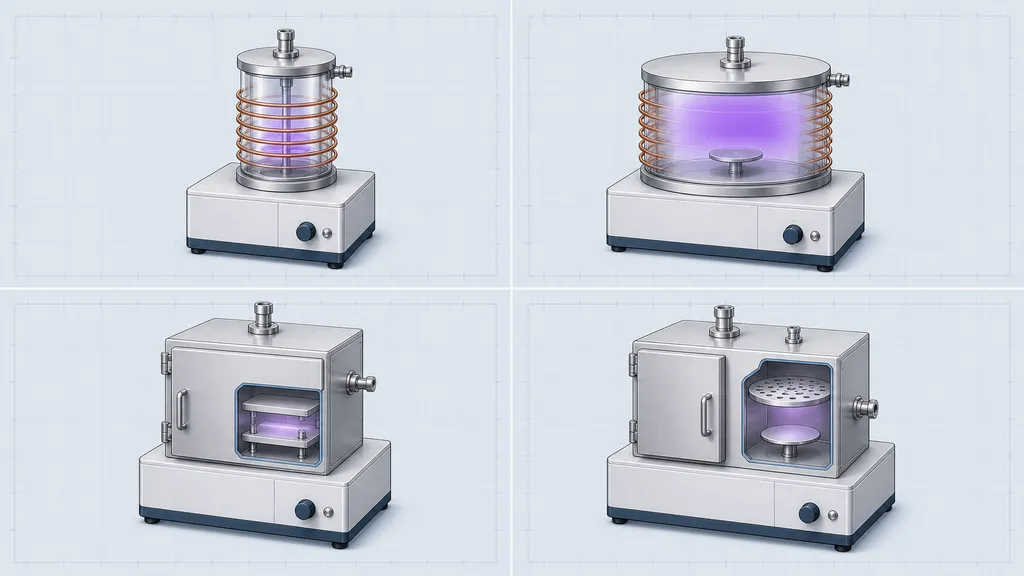
Anyone who has tried to compare benchtop plasma cleaners across manufacturers has run into the same wall: the datasheets are not comparable. One vendor publishes a chamber volume, another publishes only a diameter and a length. One states a maximum wattage, another states an adjustable range, a third states three discrete power options. One publishes a price, the rest publish a quote form. Put four datasheets side by side and the differences you see are as much about disclosure practice as about the equipment.
This article does not resolve that by filling the gaps with estimates. It does the opposite: it records exactly what each manufacturer published in the materials reviewed, and reports the gaps as findings. Every factual cell carries a numbered link to the official page or datasheet it came from. Nothing is inferred, and where two official sources disagree, both values appear.
As of date: 2026-08-12. Specifications change. Every source below was read on that date, and the article is scheduled for review on 2027-02-12.
Methodology
The credibility of a comparison table rests entirely on its sourcing rules, so those come first rather than in a footnote.
Sources
Only two source classes were accepted: manufacturer-controlled public product pages and manufacturer-hosted official documents. Distributor listings, search-result snippets, third-party articles, and archived copies were not used to fill any gap — including for NineScrolls' own rows. The same rule was applied to every manufacturer, this one included.
Each of the 29 sources is numbered (D-1, H-1, NS-1, P-1…) and listed in full at the end with its URL, title, access date, the model and configuration it covers, and the fields it supports. Every factual cell in the tables below links to at least one of them.
What "not found" means
Where a value is marked Not found, it means exactly this:
Not found in the manufacturer materials reviewed as of 2026-08-12; contact the manufacturer for current information.
It does not mean the manufacturer does not publish the value, and it does not mean the value does not exist. It means it was not present in the specific official pages and documents reviewed on that date. For every field marked not found below, both the model's product page and its linked official datasheet were checked before the mark was applied.
Comparable scope
The table covers benchtop, laboratory-oriented systems with a nominal chamber volume under 30 L. This is a like-for-like comparison boundary, not a statement about product capability — larger and floor-standing systems are excluded because comparing them against benchtop units in the same table would mislead, not because of anything about those systems.
The unit of comparison is a manufacturer-defined purchasable configuration, not a model name. Where a manufacturer defines discrete configurations that differ in a compared field — Diener's semi-automatic and PC control variants differ in gas supply and control unit — each gets its own row. Where a manufacturer offers mapped excitation options within one configuration, those appear as complete tuples inside a single cell, never as separate frequency and power lists that could be cross-combined into a configuration nobody sells. Where a product is offered as a matrix of interchangeable options with no way to determine from public material which combinations constitute actual configurations, it is excluded rather than expanded into configurations the manufacturer never defined.
Units and derived values
Original units are recorded verbatim, with millimetres shown alongside. Volume is in litres, power in watts, frequency in MHz or kHz as published.
Where a manufacturer publishes chamber dimensions but no volume, a computed approximate volume appears in its own column, marked computed. It is a plain cylindrical or rectangular approximation — π × (d/2)² × L — that excludes electrodes, sample trays, and all internal structures. It is not a usable process volume and it is not a manufacturer specification. It exists so that rows without a published volume are not simply blank, and it is kept in a separate column so it can never be mistaken for a published figure.
How much that distinction matters is visible in the table itself: for Diener's Zepto RIE the cylindrical approximation gives 1.70 L while the manufacturer states approximately 1 LD-1. That model is also the one configuration here with an electrode inside the chamber. A geometric approximation that ignores internal structures will overstate a chamber that contains one — which is the whole reason the two numbers are reported in separate columns rather than reconciled.
Candidates and exclusions
Every model in each manufacturer's benchtop or low-pressure line was assessed individually. A model entered the table only when three conditions were all met: a model identity, at least one comparable core specification, and an accessible official source. Exclusions and their bases:
| Model | Basis for exclusion |
|---|---|
| Diener FemtoD-3, PicoD-4, NanoD-5 | Offered as matrices of interchangeable chamber materials, lengths, generators and controls, with volumes given only as ranges (1.9–6 L, 4–15 L, 18–36 L). The reviewed material does not determine which combinations form purchasable configurations, so no unambiguous per-row specification can be stated. |
| Diener Tetra 30D-6, 100D-8, 150D-9, 320RD-10, 1440D-11, 2800D-12 | Stated chamber volumes of 34–57 L, 80–100 L, 150 L, approx. 320 L, approx. 1440 L and approx. 2800 L respectively — all above the 30 L comparison boundary. |
| Diener Tetra 45D-7 | Chamber volume stated only as "varies depending on chamber length"; the comparison boundary cannot be verified either way. |
| NineScrolls PLUTO-30NS-7 | 30 L floor-standing system; outside the benchtop under-30-L boundary. |
| PIE Scientific Tergeo-EMP-4 | No chamber dimensions, material or volume found in the reviewed materials, so compliance with the under-30-L boundary cannot be verified. Its other published specifications are excluded from this article's counts as well, so that an excluded model's data does not re-enter the conclusions. |
What this article does not do
It contains no independent testing, no ranking, no composite score, and no recommendation of one system over another. Several manufacturers make comparative performance claims on their own pages; none of those claims is reproduced here, in either direction, because this article has no basis on which to evaluate them.
NineScrolls' own specification tables carry the qualifier "Representative configuration; confirm process-specific configuration during quote review"NS-4. That qualifier applies to the NineScrolls rows below as it does on the product pages themselves.
Chamber and electrode architecture
Two structural distinctions drive most of what follows, and they are frequently conflated.
Electrode placement is a chamber-construction property: the electrodes sit either outside the vacuum chamber wall or inside it. Diener's Zepto and Atto configurations place an electrode pair outside the chamberD-1D-2; the Zepto RIE places it insideD-1. PIE Scientific's Tergeo-Plus and Tergeo-Pro use external electrodes and antenna designsP-2P-3. NineScrolls' PLUTO configurations use in-chamber flat plate or perforated gas-shower plate electrodesNS-4NS-5NS-6.
Treatment mode is an operating property, not a chamber property, and the two do not map onto each other. A single chamber can support direct (immersion) mode, downstream/remote mode, or both. PIE's Tergeo and Tergeo-Plus state both direct and downstream modesP-1P-2; the Tergeo-Pro page states capacitively coupled direct discharge onlyP-3. Because these are separate properties, they occupy separate columns below.
Chamber material is a third, independent axis, and it is worth naming precisely. Pyrex is a Corning brand of borosilicate glass; borosilicate glass is the material class; quartz — fused silica — is a different material with different properties. Harrick's chambers are Pyrex as standard with an optional quartz chamberH-1; Diener's are borosilicate glass, except the Zepto RIE which is aluminiumD-1; PIE's are quartzP-1. Merging these into one label would suggest equivalences that do not hold.
Published specifications — chamber and construction
18 configurations, grouped by manufacturer in alphabetical order. Every cell links to its source.
| Configuration | Electrode placement | Treatment modes | Chamber material | Chamber dimensions | Manufacturer-stated volume | Computed approx. volume |
|---|---|---|---|---|---|---|
| Diener electronic | ||||||
| Zepto RIE, semi-automatic MHzD-1 | Inside the chamber, Ø 160 mm for max. 6″ waferD-1 | Not found | Aluminium, round with lidD-1 | Ø 190 mm, H 60 mmD-1 | approx. 1 LD-1 | 1.70 L computed |
| Zepto One, semi-automaticD-1 | Electrode pair outside the chamberD-1 | Not found | Borosilicate glass, round with lidD-1 | Ø 105 mm, D 200 mmD-1 | approx. 1.7 LD-1 | 1.73 L computed |
| Zepto, semi-automaticD-1 | Electrode pair outside the chamberD-1 | Not found | Borosilicate glass, round, hinged doorD-1 | Ø 105 mm, D 300 mmD-1 | approx. 2.6 LD-1 | 2.60 L computed |
| Zepto, PC controlD-1 | Electrode pair outside the chamberD-1 | Not found | Borosilicate glass, round, hinged doorD-1 | Ø 105 mm, D 300 mmD-1 | approx. 2.6 LD-1 | 2.60 L computed |
| Atto, semi-automaticD-2 | Outside the vacuum chamberD-2 | Not found | Borosilicate glass, round, hinged doorD-2 | Ø 211 mm, D 300 mmD-2 | approx. 10.5 LD-2 | 10.49 L computed |
| Atto, PC controlD-2 | Outside the vacuum chamberD-2 | Not found | Borosilicate glass, round, hinged doorD-2 | Ø 211 mm, D 300 mmD-2 | approx. 10.5 LD-2 | 10.49 L computed |
| Harrick Plasma | ||||||
| PDC-32G (115 V) / PDC-32G-2 (230 V)H-1 | Not found | Not found | Pyrex standard; optional quartz chamberH-1H-4 | 3″ dia. × 6.5″ length (76.2 × 165.1 mm)H-1 | Not found | 0.75 L computed |
| PDC-001 (115 V) / PDC-002 (230 V)H-2 | Not found | Not found | Pyrex standard; optional quartz chamberH-2H-5 | 6″ dia. × 6.5″ length (152.4 × 165.1 mm)H-2 | Not found | 3.01 L computed |
| PDC-001-HP (115 V) / PDC-002-HP (230 V)H-3 | Not found | Not found | Pyrex standard; optional quartz chamberH-3H-6 | 6″ dia. × 6.5″ length (152.4 × 165.1 mm)H-3 | Not found | 3.01 L computed |
| NineScrolls — representative configurations; confirm process-specific configuration during quote reviewNS-4 | ||||||
| HY-4LNS-1 | Not found | Not found | Not found | Not found | 4 LNS-1 | Not computed — no published dimensions |
| PLUTO-TNS-4 | 95 × 170 mm flat plate, in chamberNS-4 | Not found | Stainless steelNS-4 | φ150 mm × 245 mm depthNS-4 | ~4.3 LNS-4 | 4.33 L computed |
| PLUTO-MNS-5 | 125 × 125 mm perforated gas-shower plate, in chamberNS-5 | Not found | Stainless steelNS-5 | φ210 mm × 230 mmNS-5 | ~8 LNS-5 | 7.97 L computed |
| PLUTO-FNS-6 | 205 × 205 mm flat plate, in chamberNS-6 | Not found | 6061-T6 aluminium alloyNS-6 | 240 × 300 × 200 mmNS-6 | ~14.5 LNS-6 | 14.40 L computed |
| HY-20LNS-2 | Not found | Not found | Stainless steelNS-2 | 250 × 250 × 320 mmNS-2 | 20 LNS-2 | 20.00 L computed |
| HY-20LRFNS-3 | Not found | Not found | Stainless steelNS-3 | 250 × 250 × 320 mmNS-3 | 20 LNS-3 | 20.00 L computed |
| PIE Scientific | ||||||
| TergeoP-1 | Not found | Direct (high-speed) and downstream (gentle); continuous and pulsedP-1 | QuartzP-1 | ID 4.3″ (110 mm), depth 11″ (280 mm)P-1 | Not found | 2.66 L computed |
| Tergeo-PlusP-2 | External RF electrodes and antenna designP-2 | Direct and downstream, dual plasma sources; continuous and pulsedP-2 | Aluminium flange with thick-wall high-purity quartz tubeP-2 | ID 160 mm, OD 170 mm, depth 280 mmP-2 | Not found | 5.63 L computed |
| Tergeo-ProP-3 | External curved capacitively coupled electrodesP-3 | Capacitively coupled direct discharge; continuous and pulsedP-3 | Aluminium flange with thick-wall high-purity quartz tubeP-3 | ID 9″/230 mm, OD 9.44″/240 mm. Depth reported inconsistently on the same page: 13.4″ / 340 mm in the specification rows, 13.4″ / 430 mm in the descriptive copyP-3 | Not found | Not computed because the reviewed official source reports conflicting chamber-depth values |
Published specifications — excitation, gas and control
Excitation options appear as complete tuples. Where a manufacturer publishes a price per configuration, the price is part of the tuple rather than a separate figure, so that a frequency, a power and a price cannot be recombined into a configuration that is not sold.
| Configuration | Excitation (frequency — power — price where published per configuration) | Power basis as published | Gas lines / MFC | Recipe management | Price disclosure |
|---|---|---|---|---|---|
| Diener electronic | |||||
| Zepto RIE, semi-automatic MHz | 13.56 MHz — 0–200 WD-1 | Power output range | 2 × needle valveD-1 | Semi-automatic control unitD-1 | Quote requested via published enquiry mechanismD-1 |
| Zepto One, semi-automatic | 100 kHz — 0–30 W 13.56 MHz — 0–30 WD-1 |
Power output range | 1 × needle valveD-1 | Semi-automatic control unitD-1 | Quote requested via published enquiry mechanismD-1 |
| Zepto, semi-automatic | 40 kHz — 0–100 W 13.56 MHz — 0–200 WD-1 |
Power output range | 2 × needle valveD-1 | Semi-automatic control unitD-1 | Quote requested via published enquiry mechanismD-1 |
| Zepto, PC control | 40 kHz — 0–100 W 13.56 MHz — 0–200 WD-1 |
Power output range | 2 × MFCD-1 | 7″ Basic PC control unit (Windows Embedded Compact 7)D-1 | Quote requested via published enquiry mechanismD-1 |
| Atto, semi-automatic | 40 kHz — 0–200 W 13.56 MHz — 0–300 WD-2 |
Power output range | 2 × needle valveD-2 | Semi-automatic control unitD-2 | Quote requested via published enquiry mechanismD-2 |
| Atto, PC control | 40 kHz — 0–200 W 13.56 MHz — 0–300 WD-2 |
Power output range | 2 × MFCD-2 | 7″ Basic PC control unit (Windows Embedded Compact 7)D-2 | Quote requested via published enquiry mechanismD-2 |
| Harrick Plasma | |||||
| PDC-32G / PDC-32G-2 | Frequency not found — 18 WH-1H-4 | Maximum; adjustable settings Low / Medium / HighH-1 | 1/8″ NPT metering valve and 3-way valve; optional PlasmaFlo mixer for quantitative control of up to two process gasesH-1H-4 | Not found | Quote requested via published price-list requestH-1 |
| PDC-001 / PDC-002 | Frequency not found — 30 WH-2H-5 | Maximum; adjustable settings Low / Medium / HighH-2 | 1/8″ NPT metering valve and 3-way valve; optional PlasmaFlo mixerH-2H-5 | Not found | Quote requested via published price-list requestH-1 |
| PDC-001-HP / PDC-002-HP | Frequency not found — 45 WH-3H-6 | Maximum, published with the qualifier that its Low setting is equivalent to the High setting on PDC-001/PDC-002H-6 | 1/8″ NPT metering valve and 3-way valve; optional PlasmaFlo mixerH-3H-6 | Not found | Quote requested via published price-list requestH-1 |
| NineScrolls — representative configurations; confirm process-specific configuration during quote reviewNS-4 | |||||
| HY-4L | RF 13.56 MHz — 150 W — $7,999 MF 40 kHz — 300 W — $6,499NS-1 |
Rated, per excitation option | 2 gas channelsNS-1 | PLC + touchscreenNS-1 | Public list price, per configurationNS-1NS-7 |
| PLUTO-T | 13.56 MHz — 0–200 W — $9,999NS-4 | Adjustable range, 1 W precision | 1 standard, optional 2nd (O₂ / N₂ / Ar)NS-4 | 4.3 in touchscreen, fully automatedNS-4 | Public list priceNS-4 |
| PLUTO-M | 13.56 MHz — 0–200 W — $12,999NS-5 | Adjustable range, 1 W precision | 2 lines, 6 mm connectors (O₂ / N₂ / Ar)NS-5 | 4.3 in touchscreen, multi-level menu; no recipe storage statedNS-5 | Public list priceNS-5 |
| PLUTO-F | 13.56 MHz — 0–500 W — $15,999NS-6 | Adjustable range, 1 W precision | 2 lines, needle valve control (O₂ / N₂ / Ar)NS-6 | 4.3 in touchscreen, multi-level menu; no recipe storage statedNS-6 | Public list priceNS-6 |
| HY-20L | RF 13.56 MHz — 150 W — $14,999 MF 40 kHz — 300 W — $11,999NS-2 |
Rated, per excitation option | 2 gas channelsNS-2 | PLC + touchscreenNS-2 | Public list price, per configurationNS-2NS-7 |
| HY-20LRF | 13.56 MHz — 300 W — $14,499NS-3 | Rated | 2 gas linesNS-3 | PLC + touchscreen, auto / manual, documented process; 4-layer sample trayNS-3 | Public list priceNS-3 |
| PIE Scientific | |||||
| Tergeo | 13.56 MHz — 0–75 W or 0–150 WP-1 | Adjustable range options, 1 W increments via recipe settings | Up to three MFC-regulated channelsP-1 | Fully automated operation from customizable pre-set recipesP-1 | Quote requested via published quotation requestP-1 |
| Tergeo-Plus | 13.56 MHz — 150 W, 300 W or 500 WP-2 | Discrete options, adjustable at 1 W interval | Up to three MFC-controlled inputs (0–100 sccm) plus venting portP-2 | 20 customizable recipes; up to three steps per job sequenceP-2 | Quote requested via published quotation requestP-1 |
| Tergeo-Pro | 13.56 MHz — 150 W, 300 W or 500 WP-3 | Discrete options, adjustable at 1 W interval | Up to three MFC-controlled inputs (0–100 sccm) plus venting portP-3 | 20 customizable recipes; up to three steps per job sequenceP-3 | Quote requested via published quotation requestP-1 |
What the disclosure pattern shows
Read down the columns rather than across the rows and a second set of findings appears — not about the equipment, but about what buyers can and cannot compare before they contact a vendor.
Chamber volume is published by two of the four manufacturers. Diener and NineScrolls state a nominal volume for every configuration reviewed. For Harrick and PIE Scientific, no manufacturer-stated volume was found on any product page or datasheet reviewed; those rows carry only dimensions, which is why the computed column exists at all. A buyer sizing a chamber against a sample has to do the arithmetic themselves for half the market surveyed here — and, as the Zepto RIE case shows, that arithmetic can diverge substantially from a manufacturer's own figure when internal structures are present.
RF frequency was not found for any Harrick configuration. It is absent from all three product pages and from all three manufacturer-hosted datasheets. The other three manufacturers publish it for every configuration. Frequency is not a cosmetic specification — 13.56 MHz is the ISM band around which most published plasma process literature is built, so its absence affects whether a lab can map published recipes onto a system before purchase.
Power is published on four different bases. Harrick publishes a maximum with three named settings; Diener publishes an output range; PIE publishes discrete wattage options with 1 W adjustment; NineScrolls publishes a rated value per excitation option for the HY series and an adjustable range for the PLUTO series. A "150 W" system and a "150 W" system are not necessarily comparable, which is why every power figure in the table above carries its basis.
Treatment mode is published unevenly. PIE Scientific states direct and downstream modes explicitly for each model. For the Diener, Harrick and NineScrolls configurations reviewed, no treatment-mode statement was found — which does not mean those systems lack modes, only that the reviewed materials did not state them.
Price disclosure splits cleanly. NineScrolls was the only manufacturer in the reviewed set for which public list pricing was found, published per configuration on models offering both RF and mid-frequency excitation. Diener, Harrick and PIE Scientific each publish an explicit quote mechanism instead — a request form or enquiry link. That is a disclosure choice, not an absence: all three tell buyers exactly how to obtain a price, and none publishes the figure itself.
Using this table
Three cautions, all of which follow from how the table was built.
First, a Not found mark is a statement about the reviewed materials on 2026-08-12, not about the manufacturer. Any of these values may be available on request, in documentation not published on the web, or on pages added since. Ask.
Second, the computed volumes are geometry, not specifications. They ignore electrodes, trays and internal structure. Use them to sanity-check whether a sample plausibly fits, never as a process volume.
Third, none of these columns measures performance. Chamber size, wattage and gas-line count describe what a system is, not how well it cleans a particular substrate. Two systems with identical published specifications can behave differently on your samples, and nothing in this article should be read as a substitute for process trials.
Sources
All 29 sources were read on 2026-08-12. Every source listed here supports at least one cell above, and every cell above links to at least one source here.
Diener electronic
- D-1 — "Low-pressure plasma system: Zepto Plasma Cleaner", plasma.com/en/low-pressureplasmasystem-zepto/. Covers Zepto One, Zepto semi-automatic, Zepto PC and Zepto RIE. Supports: chamber material, dimensions, stated volume, generator tuples, gas supply, electrode placement, control unit, enquiry mechanism.
- D-2 — "Low-pressure plasma system: Atto Plasma Cleaner", plasma.com/en/low-pressureplasmasystem-atto/. Covers Atto semi-automatic and Atto PC. Supports: chamber material, dimensions, stated volume, generator tuples, gas supply, electrode placement, control unit.
- D-3 — "Femto", plasma.com/en/low-pressureplasma-femto/. Supports the exclusion basis only.
- D-4 — "Pico", plasma.com/en/low-pressure-plasma-pico/. Exclusion basis only.
- D-5 — "Nano", plasma.com/en/low-pressure-plasma-nano/. Exclusion basis only.
- D-6 — "Tetra 30", plasma.com/en/low-pressure-plasma-tetra-30/. Exclusion basis only.
- D-7 — "Tetra 45", plasma.com/en/low-pressure-plasma-tetra-45/. Exclusion basis only.
- D-8 — "Tetra 100", plasma.com/en/low-pressure-plasma-tetra-100/. Exclusion basis only.
- D-9 — "Tetra 150", plasma.com/en/low-pressure-plasma-tetra-150/. Exclusion basis only.
- D-10 — "Tetra 320R", plasma.com/en/low-pressure-plasma-tetra-320r/. Exclusion basis only.
- D-11 — "Tetra 1440", plasma.com/en/tetra-1440/. Exclusion basis only.
- D-12 — "Tetra 2800", plasma.com/en/low-pressure-plasma-tetra-2800/. Exclusion basis only.
Harrick Plasma
- H-1 — "Basic Plasma Cleaner", harrickplasma.com/plasma-cleaners/basic-plasma-cleaner/. PDC-32G (115 V) / PDC-32G-2 (230 V). Supports: chamber dimensions and material, maximum RF power, power settings, gas valves, optional accessories, price-list request mechanism.
- H-2 — "Expanded Plasma Cleaner", harrickplasma.com/plasma-cleaners/expanded-plasma-cleaner/. PDC-001 / PDC-002. Same field set.
- H-3 — "High Power Expanded Plasma Cleaner", harrickplasma.com/plasma-cleaners/high-powered-expanded-plasma-cleaner/. PDC-001-HP / PDC-002-HP. Same field set.
- H-4 — "BASIC PLASMA CLEANER" datasheet (PDF, 1 page; no version number or revision date stated), Harrick-Plasma-Basic-Cleaner.pdf. Supports the same fields as H-1 and confirms RF frequency is absent from the datasheet. Notes the integral vacuum-pump switch is 115 V model only, a qualifier not present on the web page.
- H-5 — "EXPANDED PLASMA CLEANER" datasheet (PDF, 1 page; no version or date stated), Harrick-Plasma-Expanded-Cleaner.pdf. Qualifies the pump switch as not available in the CE model.
- H-6 — "HIGH POWER EXPANDED PLASMA CLEANER" datasheet (PDF, 1 page; no version or date stated), Harrick-Plasma-HP-Expanded-Cleaner.pdf. Source of the 45 W maximum and of the qualifier that its Low setting equals the High setting on PDC-001/PDC-002.
NineScrolls
NineScrolls specification tables are published with the qualifier "representative configuration; confirm process-specific configuration during quote review".
- NS-1 — "HY-4L Plasma Cleaner", ninescrolls.com/products/hy-4l. Supports: chamber volume, RF and MF frequency and power, gas channels, control, and the per-configuration prices (RF $7,999 / MF $6,499) shown by the page's configuration selector.
- NS-2 — "HY-20L Batch Plasma Processing System", ninescrolls.com/products/hy-20l. Supports: chamber volume, material, internal size, RF and MF tuples, gas channels, control, per-configuration prices (RF $14,999 / MF $11,999).
- NS-3 — HY-20LRF product page, ninescrolls.com/products/hy-20lrf. Supports: chamber volume, material, internal size, RF frequency and power, gas lines, control, sample tray, price.
- NS-4 — "PLUTO-T Compact RF Plasma Cleaner", ninescrolls.com/products/pluto-t. Supports: chamber volume and material, chamber size, RF power and frequency, electrode, gas lines, control, price, and the representative-configuration qualifier.
- NS-5 — "PLUTO-M Mid-Capacity RF Plasma Cleaner", ninescrolls.com/products/pluto-m. Same field set.
- NS-6 — "PLUTO-F Flagship RF Plasma Cleaner", ninescrolls.com/products/pluto-f. Same field set.
- NS-7 — Products listing, ninescrolls.com/products. Supports: listing-card from-prices and the PLUTO-30 scope exclusion.
PIE Scientific
- P-1 — "Tergeo plasma cleaner", piescientific.com/tergeo_plasma_cleaner/. Supports: frequency, power options, chamber material and dimensions, gas channels, treatment modes, recipe control, quotation request mechanism.
- P-2 — "Tergeo-Plus Tabletop Plasma System", piescientific.com/tergeo-plus_plasma_cleaner/. Supports: chamber size and construction, RF power options, gas inputs, electrode design, recipes, treatment modes.
- P-3 — "Tergeo-Pro Tabletop Plasma System", piescientific.com/tergeo-pro-plasma-cleaner/. Supports: chamber diameter and construction, RF power options, gas inputs, electrode design, recipes, discharge method. Also the source of the internally inconsistent chamber-depth values recorded in the table.
- P-4 — "TEM and SEM plasma cleaner" (Tergeo-EM), piescientific.com/tergeo-em_plasma_cleaner/. Supports the Tergeo-EM exclusion basis only; contributes no cell to the tables and is excluded from the disclosure counts.
Disclaimer
This comparison is drawn from publicly available manufacturer information — official product pages and manufacturer-hosted documents — and reports objective specifications alongside what was and was not found in the manufacturer materials reviewed as of the stated access dates. It does not include independent side-by-side performance testing, and makes no judgment about cleaning results, uniformity, reliability, or overall performance. Specifications and availability change without notice: verify current information with the manufacturer before making a purchasing decision. Product and brand names are the trademarks of their respective owners, are used here for identification only, and imply no sponsorship, endorsement, or affiliation.