
Most equipment guides end with a recommendation. This one cannot, and the reason is worth stating up front: the only information used here is what four manufacturers publish, and published specifications describe what a system is, never how well it will clean your particular samples. Any guide that turns a wattage figure into a "best for" verdict has crossed from evidence into guesswork.
What published specifications can do is eliminate. If your samples do not fit the chamber, no amount of process tuning helps. If your procurement office needs a price before it will open a requisition, a quote-only vendor changes your timeline. Constraints like these are answerable from official material, and answering them narrows an 18-configuration field before you spend time on demos.
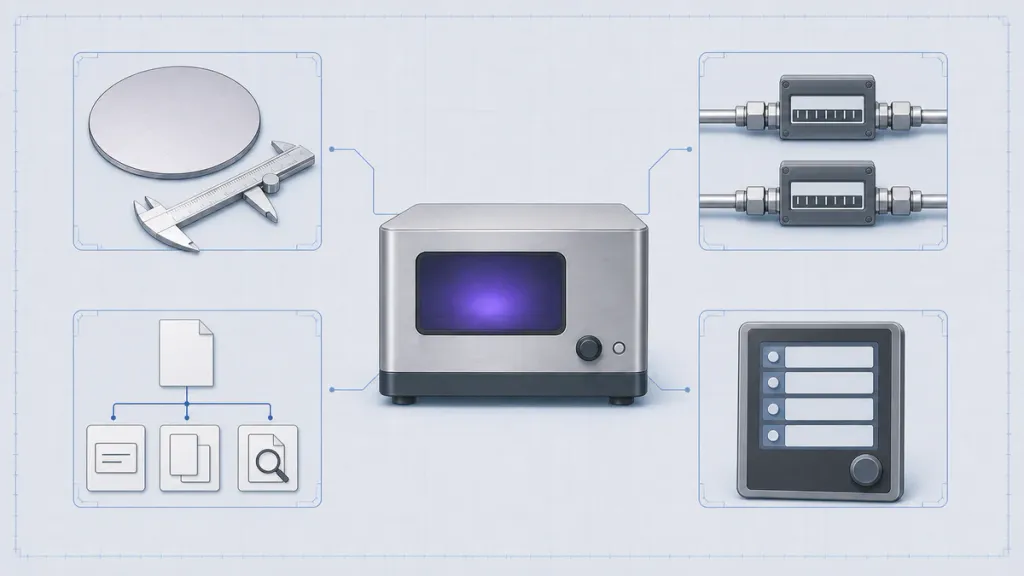
This article works through four such constraints. Each returns a set, not a winner.
As of date: 2026-08-12. Every specification cited was read on that date from the sources listed at the end. The underlying comparison, including the full 29-source ledger and the models excluded from scope, is in the companion article Benchtop Plasma Cleaner Specifications: What Four Manufacturers Publish.
How to read the sets
Each constraint below returns three sets, and the third one matters as much as the first:
- Published specifications satisfy the condition — the official material states a value that meets it.
- Published specifications do not satisfy the condition — the official material states a value that does not meet it.
- Reviewed materials do not say — no value was found either way in the manufacturer materials reviewed as of 2026-08-12.
A configuration in the third set is not a configuration that lacks the capability. It is one where the published material is silent. Treating silence as absence would penalise manufacturers for terse datasheets and reward those with verbose ones, which measures documentation, not equipment. Where a configuration lands in that set, the practical next step is to ask the manufacturer — the answer may well move it into the first.
Two things this article never does: it does not infer cleaning speed, uniformity, or process outcome from power, architecture or chamber volume; and it does not rank, score, or nominate a default. Sets are presented in a fixed order — Diener, Harrick, NineScrolls, PIE Scientific — for every constraint, so that ordering carries no meaning.
Constraint 1 — Will the sample fit?
This is the constraint that cannot be worked around, and it is also the one where a single number misleads most often. Chamber volume is not a proxy for what fits. A 2.6 L cylinder 105 mm across takes nothing wider than 105 mm regardless of its length; a 20 L rectangular chamber 250 mm across takes a much larger flat sample at a fraction of the aspect ratio. Compare the dimension that constrains your sample, not the litre figure.
Configurations with an explicitly published sample capacity
Three configurations state what they hold, in the manufacturer's own terms — the most directly usable form of this specification:
- Diener Zepto RIE — electrode Ø 160 mm for a maximum 6″ waferD-1
- PIE Scientific Tergeo-Plus — stated as accommodating a 4-inch wafer boat and one 6-inch waferP-2
- PIE Scientific Tergeo-Pro — stated as holding an 8-inch wafer, or one to two 25/50-slot 6″ or 4″ quartz wafer boatsP-3
Configurations where you compute the fit from published dimensions
Cylindrical chambers, constrained by internal diameter:
- Ø 105 mm — Diener Zepto One (D 200 mm), Zepto semi-automatic and Zepto PC (D 300 mm)D-1
- Ø 110 mm — PIE Scientific Tergeo (depth 280 mm)P-1
- Ø 148 mm — NineScrolls HY-4L (266 mm depth; usable load 220 × 110 × 90 mm)NS-1
- Ø 150 mm — NineScrolls PLUTO-T (245 mm depth)NS-4
- Ø 160 mm — PIE Scientific Tergeo-Plus (depth 280 mm)P-2
- Ø 190 mm — Diener Zepto RIE (H 60 mm — a shallow chamber, wide but not deep)D-1
- Ø 210 mm — NineScrolls PLUTO-M (230 mm)NS-5
- Ø 211 mm — Diener Atto, both control variants (D 300 mm)D-2
- Ø 230 mm — PIE Scientific Tergeo-Pro; note the depth is published inconsistently on the source page (340 mm in the specification rows, 430 mm in the descriptive copy), so depth-critical samples need confirmationP-3
- 3″ (76.2 mm) and 6″ (152.4 mm) diameter × 6.5″ (165.1 mm) length — Harrick PDC-32G, and PDC-001 / PDC-001-HP respectivelyH-1H-2H-3
Rectangular chambers, which suit flat samples that a cylinder of the same volume would not take:
- 240 × 300 × 200 mm — NineScrolls PLUTO-FNS-6
- 250 × 250 × 320 mm — NineScrolls HY-20L and HY-20LRFNS-2NS-3
Constraint 2 — Do you need quantitative gas control?
Two distinct capabilities get conflated here. A needle or metering valve sets flow by hand against a pressure reading; Harrick's own material describes its metering valve as controlling gas flow qualitativelyH-1. A mass flow controller holds a setpoint in sccm, which is what makes a gas recipe transferable between runs, operators and sites. If you intend to reproduce a published process or transfer a recipe to another lab, this distinction matters more than channel count.
Published specifications include mass flow control
- Diener Zepto PC and Atto PC — 2 × MFCD-1D-2
- Harrick PDC-32G, PDC-001, PDC-001-HP — via the optional PlasmaFlo mixer, described as giving quantitative control of up to two process gases; the base configuration is valve-controlledH-1H-4H-5H-6
- PIE Scientific Tergeo, Tergeo-Plus, Tergeo-Pro — up to three MFC-regulated channels; the Plus and Pro state 0–100 sccm rangesP-1P-2P-3
Published specifications describe valve control
- Diener Zepto One — 1 × needle valveD-1
- Diener Zepto semi-automatic, Zepto RIE, Atto semi-automatic — 2 × needle valveD-1D-2
- NineScrolls PLUTO-F — 2 lines with needle valve control (O₂ / N₂ / Ar)NS-6
Reviewed materials do not say
Four NineScrolls configurations publish a channel count without stating the control method: HY-4L, HY-20L and HY-20LRF state two gas channels or linesNS-1NS-2NS-3, and PLUTO-M states two lines with 6 mm connectorsNS-5. PLUTO-T states one line as standard with an optional second, again without a stated control methodNS-4. Whether any of these use mass flow control cannot be determined from the reviewed material.
Constraint 3 — Does your process need a price before a conversation?
This constraint is about procurement mechanics, not cost. Institutional buyers on grant funding, capital requisitions or fixed-quarter budgets frequently need a defensible figure before a purchase can be initiated. Others are perfectly able to run a quote cycle first. Which situation you are in changes the shortlist; it says nothing about which systems cost more.
A quote requirement is not a proxy for a higher price. Quote-based pricing is standard practice for configurable laboratory capital equipment, and all three manufacturers below publish a clear route to a figure. Nothing in the reviewed material supports any inference about relative cost between the two groups, and none is made here.
Published list prices, per configuration
NineScrolls publishes a price for each configuration. Where a model offers both excitation options, each option carries its own price, so frequency, power and price travel together:
- HY-4L — RF 13.56 MHz / 150 W / $7,999; MF 40 kHz / 300 W / $6,499NS-1
- PLUTO-T — 13.56 MHz / 0–200 W / $9,999NS-4
- PLUTO-M — 13.56 MHz / 0–200 W / $12,999NS-5
- HY-20LRF — 13.56 MHz / 300 W / $14,499NS-3
- HY-20L — RF 13.56 MHz / 150 W / $14,999; MF 40 kHz / 300 W / $11,999NS-2
- PLUTO-F — 13.56 MHz / 0–500 W / $15,999NS-6
Published quote mechanism
- Diener — Zepto One, Zepto semi-automatic, Zepto PC, Zepto RIE, Atto semi-automatic, Atto PC: enquiry and quotation request published on the product pagesD-1D-2
- Harrick — PDC-32G, PDC-001, PDC-001-HP: price list and formal quote request published on the product pageH-1
- PIE Scientific — Tergeo, Tergeo-Plus, Tergeo-Pro: price quotation request published on the product pageP-1
No price and no quote route found
None. Every configuration in the comparison either publishes a price or publishes an explicit way to request one.
Constraint 4 — Do you need stored, repeatable recipes?
In a shared facility, the question is usually not whether a system can reach a process condition but whether the same condition can be reproduced by a different operator next month. Stored recipes and logged runs are what make that auditable. This section reports what each manufacturer states about recipe handling — it does not assess how reproducible any system actually is, which no published specification can tell you.
Published specifications include stored, named recipes
- PIE Scientific Tergeo-Plus and Tergeo-Pro — 20 customizable recipes, with job sequences of up to three stepsP-2P-3
- PIE Scientific Tergeo — fully automated operation from customizable pre-set recipes, with run-log storageP-1
Published specifications describe a control system without stating recipe storage
- NineScrolls PLUTO-M and PLUTO-F — 4.3 in touchscreen with a multi-level application menuNS-5NS-6
- NineScrolls HY-20LRF — PLC and touchscreen, switchable between automatic and manual, with programmed automatic runsNS-3
- Diener Zepto PC and Atto PC — 7″ Basic PC control unit running Windows Embedded Compact 7D-1D-2
- Diener Zepto One, Zepto semi-automatic, Zepto RIE, Atto semi-automatic — semi-automatic control unitD-1D-2
- NineScrolls HY-4L and HY-20L — PLC and touchscreenNS-1NS-2
- NineScrolls PLUTO-T — touchscreen, fully automatedNS-4
A PC-based or PLC-based controller may well store recipes; the reviewed material simply does not state it. These belong in the "ask the manufacturer" column, not the "cannot do it" column.
Reviewed materials do not say
Harrick PDC-32G, PDC-001 and PDC-001-HP — no recipe or automation statement was found on the product pages or in the datasheetsH-1H-2H-3H-4H-5H-6. The published control interface is three RF power settings — Low, Medium, High — with valve-based gas control.
What these four constraints do not answer
Applying all four still leaves the questions that usually decide a purchase, and no published specification in this set addresses them:
- Will it clean your material? Contamination type, substrate sensitivity and acceptance criteria determine this. It is answered by process trials on your samples, not by datasheets.
- How uniform is treatment across the chamber? Nothing in the reviewed material quantifies uniformity for any configuration here, and it cannot be derived from power, electrode geometry or volume.
- What is the total cost of ownership? Vacuum pumps, consumables, service and facility requirements are largely outside the specifications compared here — several manufacturers state a required pump speed but not a pump.
- What is the lead time and service response where you are? Not a specification at all, and frequently the deciding factor.
The honest use of this article is to arrive at a demo or a quote conversation with a shorter list and sharper questions — particularly the questions raised by every "reviewed materials do not say" entry above.
Sources
All sources were read on 2026-08-12. Numbering matches the companion comparison article, whose source list also covers the models excluded from scope.
Diener electronic
- D-1 — "Low-pressure plasma system: Zepto Plasma Cleaner", plasma.com/en/low-pressureplasmasystem-zepto/. Zepto One, Zepto semi-automatic, Zepto PC, Zepto RIE: chamber dimensions, electrode, gas supply, control unit, enquiry mechanism.
- D-2 — "Low-pressure plasma system: Atto Plasma Cleaner", plasma.com/en/low-pressureplasmasystem-atto/. Atto semi-automatic and Atto PC: chamber dimensions, gas supply, control unit.
Harrick Plasma
- H-1 — "Basic Plasma Cleaner", harrickplasma.com/plasma-cleaners/basic-plasma-cleaner/. PDC-32G: chamber dimensions, valve description, optional PlasmaFlo, price-list request.
- H-2 — "Expanded Plasma Cleaner", harrickplasma.com/plasma-cleaners/expanded-plasma-cleaner/. PDC-001: same field set.
- H-3 — "High Power Expanded Plasma Cleaner", harrickplasma.com/plasma-cleaners/high-powered-expanded-plasma-cleaner/. PDC-001-HP: same field set.
- H-4 — "BASIC PLASMA CLEANER" datasheet (PDF, 1 page; no version or date stated), Harrick-Plasma-Basic-Cleaner.pdf. Confirms the optional PlasmaFlo mixer and the absence of a recipe statement.
- H-5 — "EXPANDED PLASMA CLEANER" datasheet (PDF, 1 page; no version or date stated), Harrick-Plasma-Expanded-Cleaner.pdf. Same.
- H-6 — "HIGH POWER EXPANDED PLASMA CLEANER" datasheet (PDF, 1 page; no version or date stated), Harrick-Plasma-HP-Expanded-Cleaner.pdf. Same.
NineScrolls
NineScrolls specification tables are published with the qualifier "representative configuration; confirm process-specific configuration during quote review".
- NS-1 — "HY-4L Plasma Cleaner", ninescrolls.com/products/hy-4l. Chamber volume, excitation tuples with per-configuration prices, gas channels, control.
- NS-2 — "HY-20L Batch Plasma Processing System", ninescrolls.com/products/hy-20l. Chamber volume and internal size, excitation tuples with per-configuration prices, gas channels, control.
- NS-3 — HY-20LRF product page, ninescrolls.com/products/hy-20lrf. Chamber volume and internal size, excitation, gas lines, control, price.
- NS-4 — "PLUTO-T Compact RF Plasma Cleaner", ninescrolls.com/products/pluto-t. Chamber size, excitation, gas lines, control, price, representative-configuration qualifier.
- NS-5 — "PLUTO-M Mid-Capacity RF Plasma Cleaner", ninescrolls.com/products/pluto-m. Same field set.
- NS-6 — "PLUTO-F Flagship RF Plasma Cleaner", ninescrolls.com/products/pluto-f. Same field set.
PIE Scientific
- P-1 — "Tergeo plasma cleaner", piescientific.com/tergeo_plasma_cleaner/. Chamber dimensions, MFC channels, recipe control, quotation request.
- P-2 — "Tergeo-Plus Tabletop Plasma System", piescientific.com/tergeo-plus_plasma_cleaner/. Chamber size, stated wafer capacity, MFC inputs, recipes.
- P-3 — "Tergeo-Pro Tabletop Plasma System", piescientific.com/tergeo-pro-plasma-cleaner/. Chamber diameter, stated wafer capacity, MFC inputs, recipes; also the source of the inconsistent chamber-depth values noted above.
Disclaimer
This comparison is drawn from publicly available manufacturer information — official product pages and manufacturer-hosted documents — and reports objective specifications alongside what was and was not found in the manufacturer materials reviewed as of the stated access dates. It does not include independent side-by-side performance testing, and makes no judgment about cleaning results, uniformity, reliability, or overall performance. Specifications and availability change without notice: verify current information with the manufacturer before making a purchasing decision. Product and brand names are the trademarks of their respective owners, are used here for identification only, and imply no sponsorship, endorsement, or affiliation.