
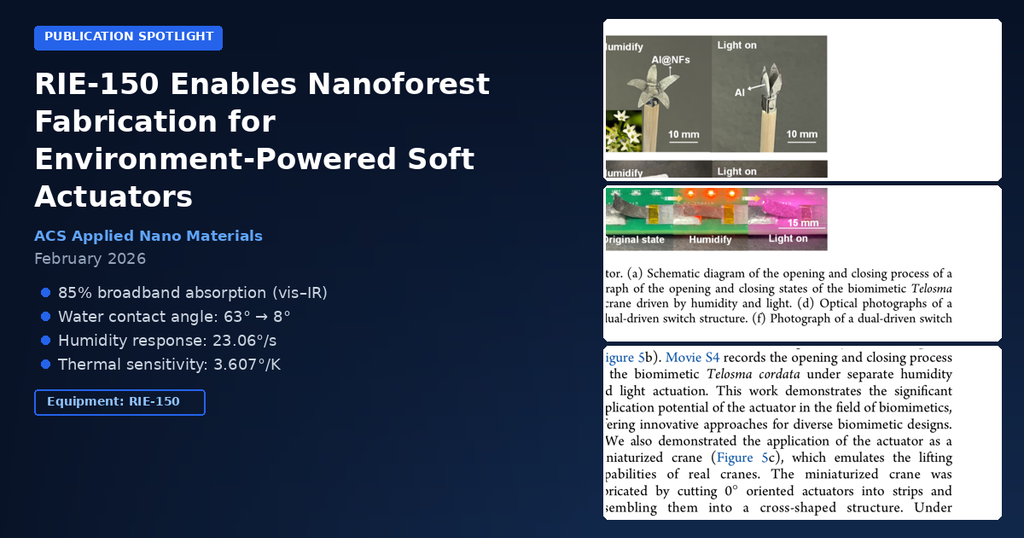
PUBLICATION SPOTLIGHT
Highlights
- Published in ACS Applied Nano Materials (American Chemical Society), February 2026
- RIE-150 oxygen plasma etching generated nanoforest structures critical to dual-mode soft actuator performance
- The actuator achieves record-level response rates and outperforms existing soft actuators in thermal sensitivity
- Demonstrated applications include biomimetic flowers, miniaturized cranes, and intelligent switches
The Research
A collaborative team from the Institute of Microelectronics at the Chinese Academy of Sciences and Fudan University has published a study demonstrating a novel environment-powered soft actuator that can be driven by both humidity and light — without any external power source.
The actuator is built on a composite nanofilm comprising aluminum-coated nanoforests (Al@NFs), uniaxially oriented Nylon-6 (PA6), and aluminum. By harvesting ambient humidity and light energy from the environment, the device achieves rapid, reversible, and programmable deformation — a significant advance over conventional single-mode soft actuators.
Reference:
Li, H. et al., "An Environment-Powered Soft Actuator Enabled by Water and Light Highly Absorptive Nanoforests," ACS Applied Nano Materials, 2026.
DOI: 10.1021/acsanm.5c05598
The Role of Plasma Etching
The nanoforest structures at the heart of this actuator were fabricated using oxygen plasma etching performed with the RIE-150 Reactive Ion Etching system (Beijing Zhongke Tailong Electronics Co., Ltd.).
Process Parameters
| Parameter | Value |
|---|---|
| Pressure | 8.3 mTorr |
| RF Power | 174 W |
| Etching Time | 20 min |
| Gas | Oxygen plasma |
The RIE-150 transformed a flat polyimide-coated PA6 surface into dense, high-aspect-ratio nanofiber forests (~3 μm height) uniformly distributed across the film. These nanoforests were subsequently coated with aluminum nanoparticles via magnetron sputtering, yielding the final Al@NFs composite structure.
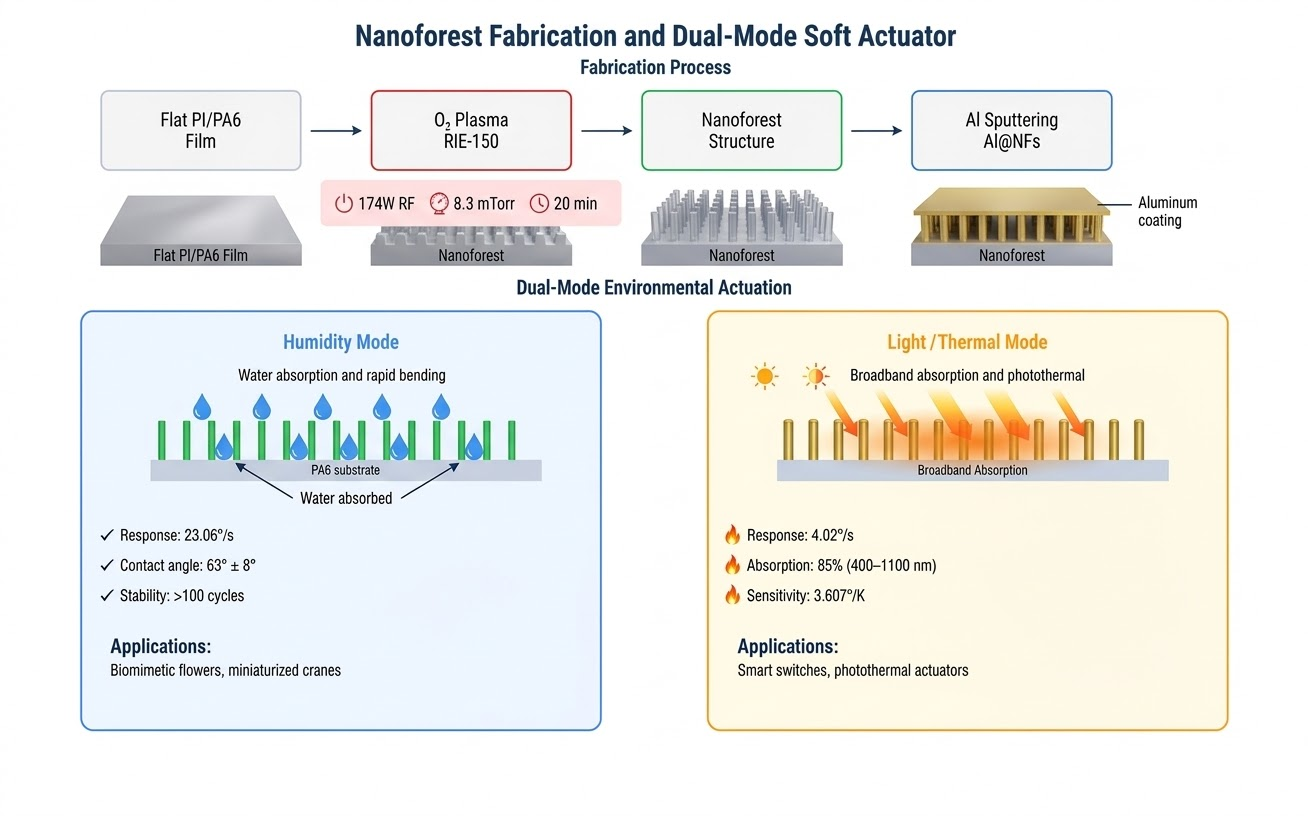
Figure 1: Nanoforest Fabrication and Actuation — RIE-150 oxygen plasma creates nanoforest structures enabling humidity-driven and photothermal response
Why the Nanoforests Matter
1. Superhydrophilicity for humidity-driven actuation
The nanoforest structure reduces the water contact angle from 63° (bare PA6) to just 8° (Al@NFs-modified surface), with complete water spreading achieved within 0.2 seconds. This dramatically enhances moisture absorption and accelerates humidity-driven deformation.
2. Broadband light absorption for photothermal actuation
The Al@NFs composite achieves an average light absorption of 85% across visible to infrared wavelengths (400–1100 nm) — a 16.87× improvement over unprocessed PA6 film. This broadband absorption is enabled by multiple hybrid surface plasmon resonance modes and light trapping effects within the nanoforest architecture.
Key Performance Results
| Metric | Value |
|---|---|
| Humidity response rate | 23.06°/s |
| Light response rate | 4.02°/s (310 mW cm⁻²) |
| Thermal response time | ~4 s |
| Bending angle temperature coefficient | 3.607°/K |
| Cycling stability | >100 cycles, no degradation |
| Broadband absorption | 85% average (400–1100 nm) |
These results outperform previously reported soft actuators in both thermal response time and bending sensitivity.
Demonstrated Applications
- Biomimetic Telosma cordata flower — blooms under humidity, closes under light, mimicking the natural behavior of night-blooming flowers
- Miniaturized crane — lifts objects several times its own weight using humidity-driven actuation
- Dual-controlled intelligent switch — controls LED on/off states adaptively based on environmental humidity and light conditions, with potential applications in smart agriculture
Equipment Used
- RIE-150 — Reactive Ion Etching system for oxygen plasma nanoforest generation
- Manufacturer: Beijing Zhongke Tailong Electronics Co., Ltd.
- Available through NineScrolls: View RIE Etcher Series →
Takeaway
This publication demonstrates that precise oxygen plasma etching — enabled by the RIE-150 — can create nanostructured surfaces with exceptional hydrophilicity and light absorption properties. These capabilities open new pathways for environment-powered soft robotics, biomimetics, and smart material systems.
For researchers working on nanostructured surfaces, soft actuators, or environmental energy harvesting, the RIE-150 offers the process control and reproducibility required to achieve publication-grade results.
Interested in learning more about our RIE systems? Request a Quote →
Related Articles
- Reactive Ion Etching (RIE) Guide — principles, applications, and equipment
- Etching Beyond Silicon — chemistry for emerging materials
- Quantum Device Micro/Nanofabrication — patterning at the nanoscale
References
- Li, H. et al., "An Environment-Powered Soft Actuator Enabled by Water and Light Highly Absorptive Nanoforests," ACS Applied Nano Materials, 2026. doi:10.1021/acsanm.5c05598