
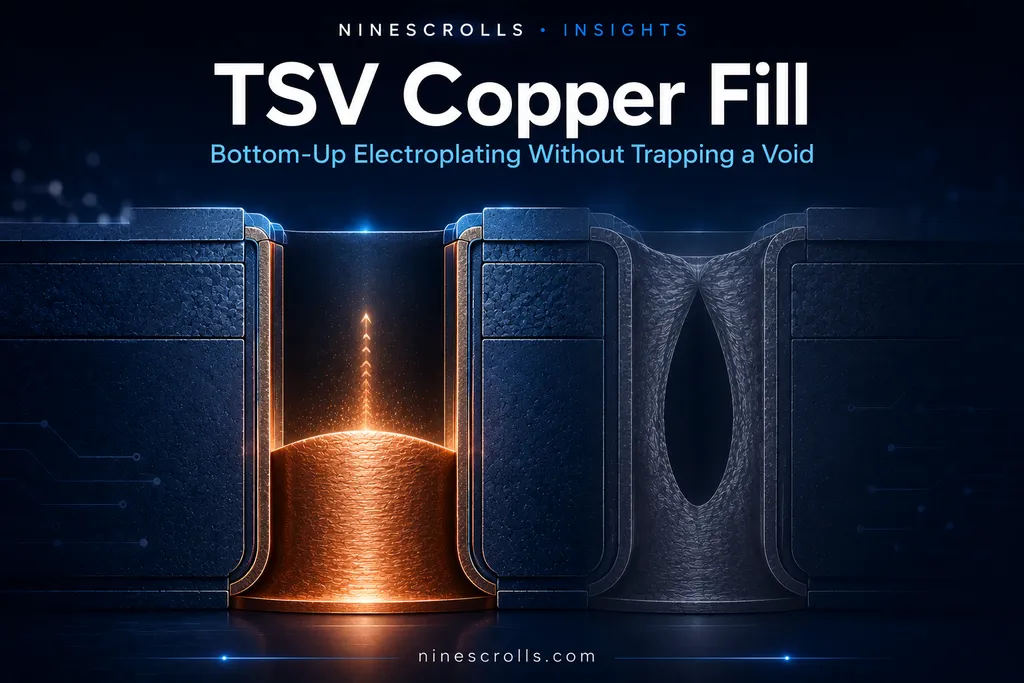
An etched, lined via is an empty well — a deep hole waiting to be filled with copper. Fill is how the copper gets in, but the hard part is not volume, it is direction: the copper has to grow from the bottom of the well upward, or it seals a void inside before the hole is full. How the via is defined and where it sits in the integration flow belongs to our TSV guide; the frontside etch that formed the well belongs to our DRIE guide; the work that later exposes the filled copper from the far side of the wafer belongs to our TSV reveal guide. This page owns one thing: copper via fill is a direction problem.
1. Why Filling a Via Is Hard
A high-aspect-ratio via is a deep, narrow hole — far taller than it is wide. The obvious way to fill it would be to deposit copper conformally, building it up evenly on every interior surface at once: sidewalls, bottom, and mouth all thickening together. But the mouth sees fresh copper just as readily as the bottom does, so the opening narrows from both sides while the deep interior is still largely empty. The mouth pinches shut before the bottom is full, and what gets sealed inside is a void — a trapped pocket where copper never arrived.
This reframes the whole problem. The difficulty is not getting copper into the via; copper is happy to plate anywhere there is a surface. The difficulty is getting it in without trapping a void — and whether a void forms is decided by the order in which the surfaces fill, that is, by where the copper grows first. Fill from the bottom upward and the trapped pocket never exists, because the deepest copper is laid down before the mouth can close. Fill everywhere at the same rate and the mouth wins the race and seals a gap below it.
So the question that decides success is not how much copper goes into the via, but where it grows first. A via with too little copper is simply underfilled, and visibly so; a via filled in the wrong direction looks full from the top yet hides a void in its core. Copper via fill is therefore a problem of controlling growth direction, not of supplying volume.
2. The Seed: What Copper Grows On
Electroplated copper — the workhorse method for filling a deep via — can only grow from a surface that already conducts. Bare silicon, and the insulating and barrier liners that coat the via wall, do not carry the plating current, so plating cannot begin on them. Before any fill copper is grown, a thin copper seed is deposited over the via's interior (it sits on top of the diffusion barrier; the full barrier-and-liner anatomy belongs to the parent TSV guide). The seed gives the plating bath something conductive to grow on.
What the seed really decides is where copper can grow at all. Plating starts only where the seed is present and continuous; the growth front begins on the seed and advances outward from it. A seed that lines the whole interior offers a complete starting surface, so copper can be coaxed to grow in the chosen direction. The seed is the answer to "where can copper grow?" — it defines the entire set of places the fill is even able to start.
That is also why seed quality maps straight onto void risk. A thin spot, a discontinuity, or a region the seed did not reach is a place where copper cannot start growing — the surrounding copper plates over and around it, sealing a void exactly where the seed was weak. A gap in the seed is therefore a gap in the growth direction: copper has nowhere to grow from there, so it closes over the spot instead of filling it. Where copper can start, and where it cannot, is set the moment the seed goes down.
3. Electroplating and the Bottom-Up Problem
Left to itself, electroplating grows copper on every wetted surface at once. The bath feeds the via mouth just as readily as it feeds the bottom, so copper thickens conformally — evenly inward on all walls — and the narrow mouth typically closes first, pinching off a void before the deep interior is full. Plain plating, in other words, drives the growth front in the wrong direction.
Bottom-up superfill rewrites that direction. Instead of letting every surface grow at the same rate, the bath is tuned so copper grows fastest at the via bottom, and the fill front rises steadily upward toward the mouth. The lever is a trio of organic additives whose balance sets where growth is fastest — three direction controls, not three volume controls:
- An accelerator concentrates at the via bottom and speeds growth there, so the deepest copper advances first.
- A suppressor slows growth on the field and the upper sidewalls, keeping the mouth from racing ahead and closing.
- A leveler tames the overburden and evens the top, holding the front flat as it emerges.
Read together, all three exist for one purpose: to make the front move up rather than in. Their balance is the steering wheel of the fill. The very same chemistry class can produce a flawless solid column or a void sealed in the core — same bath, opposite outcomes, decided entirely by which direction the front is aimed. The next section follows that front from start to finish.
4. Anneal and Frontside Overburden CMP
Once the via is solid, two finishing steps turn a freshly grown copper column into a stable, usable interconnect. The first is the anneal. As-plated copper is fine-grained and not yet settled; a controlled heating step lets the grains grow and the structure relax into its final form. What anneal stabilizes is precisely the column that the fill front built: the bottom-up growth laid copper down in a particular order, from the deepest surface upward, and the anneal locks that grown structure into a steady grain arrangement. It does not change where the copper came from — it fixes the final structure of the column that the chosen growth direction produced.
The second step follows directly from how a good fill works. Successful bottom-up growth does not stop neatly at the top of the via; it commonly keeps plating past the mouth and lays excess copper across the whole front surface of the wafer. That blanket of excess is the frontside overburden, and it has to come off before any interconnect can be built above the vias. Frontside overburden CMP — chemical-mechanical planarization — grinds and polishes that frontside overburden back to a flat plane level with the wafer surface, leaving each via filled but no longer buried under stray copper. With the frontside planar again, upper-level interconnect processing can continue. (The separate, later step that exposes the copper from the far side of the wafer is its own operation, covered in our TSV reveal guide.) In short, this is the answer to "what happens after the copper has grown correctly?" — you stabilize the column the growth created, then strip the frontside overburden it left behind.
5. The Fill-Front: Growth Direction Determines Fill Outcome
A TSV rarely fails because there is too little copper. It fails because the copper grows in the wrong place first.
Copper via fill is a direction problem, not a volume problem. The copper must grow from the bottom up — or it seals a void inside.
Everything turns on the shape of the growth front — the moving boundary where fresh copper is being laid down. Two fronts are possible, and they are opposites:
The conformal front thickens copper evenly on every wall at once. The mouth, narrowest relative to the supply it sees, reaches closure first; it pinches shut and seals a void or seam in the center while the deep interior is still hungry. Here the growth direction is sidewall-inward — two opposing fronts marching toward the core from the walls — and that direction is the failure. Nothing was undersupplied; the front simply pointed the wrong way, and once the mouth has closed no amount of further plating can reach the cavity it sealed below.
The bottom-up superfill front is the same chemistry steered differently. The additive balance concentrates growth at the bottom, so the front rises up the via like a tide and meets the mouth only once the column below is already solid — no trapped cavity, no seam. The deepest copper is committed first, the mouth last; closure happens after the via is full rather than before. Same bath, same metal, opposite outcome — set entirely by direction. State it plainly: the difference between a perfect via and a scrapped one is not how much copper was deposited but where it grew first.
Seen this way, the whole fill sequence is one continuous service to the bottom-up front. The seed lays a continuous conductive base for the front to grow from. Electroplating with superfill additives aims that front up, fastest at the bottom. The anneal then sets the grain of the solid column the rising front built. Finally, frontside overburden CMP clears the excess copper a successful front leaves spilled across the surface. Every step earns its place by how it serves the direction of growth.
Read the arrows before the void: inward growth creates closure before fill, so the cavity is sealed while the interior is still empty; upward growth creates fill before closure, so the mouth meets a column that is already solid. The two fronts are not faster and slower versions of one process — they are opposite orderings of the same two events, closure and fill, and the order is the whole outcome.
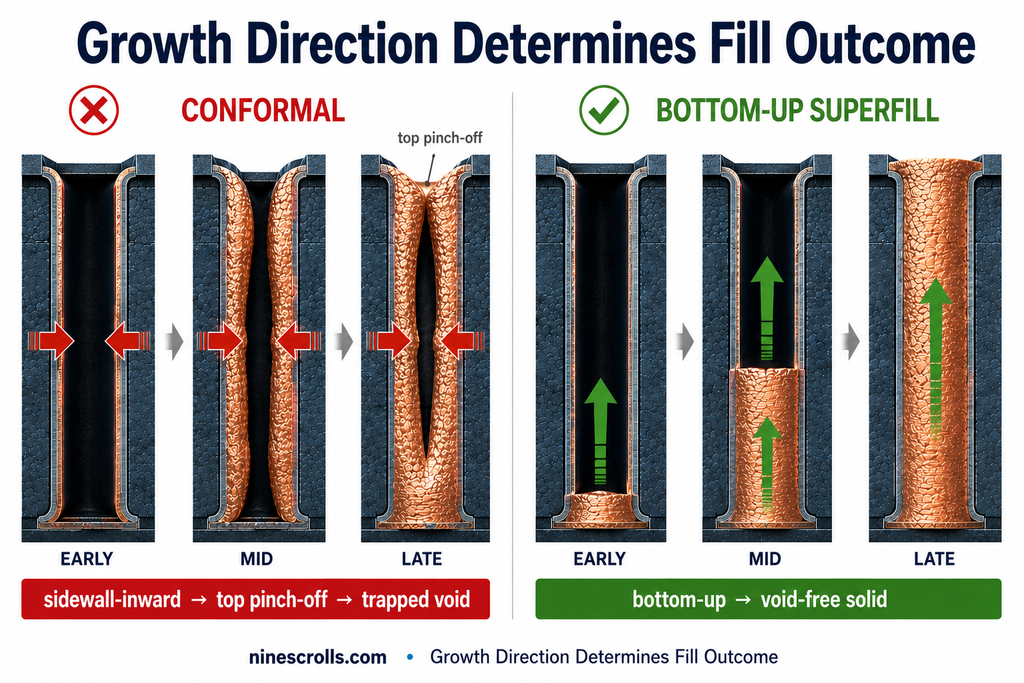
Read each panel by the direction of its arrows, not by the defect at the end: trace where the front moves first, and the outcome is already decided before the via looks full.
6. Fill Failure Modes
The defects that matter most here are the ones fill itself creates, and each is best named at the point in the growth where it begins — the answer to "what happens when copper starts growing in the wrong place?"
A center seam forms when growth runs inward from both sidewalls at once: two opposing fronts advance toward the middle and meet there, and where they join they leave a thin vertical seam down the core of the via. The cause is direction — sidewall-inward growth instead of bottom-up — not any shortage of copper.
A top pinch-off void begins at the mouth: the opening closes over before the deep interior has filled, sealing a cavity beneath a solid-looking top. Here the growth at the mouth simply outpaced the growth at the bottom, so the via finished from the top down and trapped a gap.
An incomplete fill begins where the growth front stalls: the advancing copper slows or stops before the via is solid, leaving the upper region short. The defect is located at the height where forward growth gave out.
A seed-discontinuity void begins wherever the seed never reached: copper cannot start on a bare patch, so the surrounding fill plates around that spot and closes it off. The void sits exactly where growth had no surface to begin from.
Each of these is a growth-origin problem, not a downstream symptom. What a buried void later becomes — how a trapped cavity drives system effects such as electromigration or copper pumping over the life of the part — is the reliability story, deferred in full to our 3D packaging reliability hub.
7. Why Fill Quality Carries Forward
A void laid down during fill is invisible at the moment it is created: from the front, the via looks full, the surface polishes flat, and nothing flags the trapped pocket inside. It stays buried — through anneal, through planarization, through every layer built on top — until the via is later opened from the far side of the wafer (the sibling step in our TSV reveal guide, where a trapped pocket can surface as the copper tip is uncovered) or until the finished part is stressed in service (our 3D packaging reliability hub). Fill is where the integrity of the via is silently decided — quietly, and long before anyone can measure it.
That is why the lesson of this page is about where copper grows first, not how much of it there is. A via can hold exactly the right amount of copper and still hide a defect, because what determines a clean column is the order in which its surfaces close, set by the growth front the moment plating begins. The empty well this copper fills is defined in our parent TSV guide — fill is simply the step that decides, irreversibly, whether that well becomes a sound conductor or a sealed flaw.
Frequently Asked Questions
What is TSV copper fill?
TSV copper fill is the step that puts copper into an etched, lined through-silicon via, typically by electroplating, so the via can carry a signal vertically through the wafer. The via arrives as an empty, barrier- and seed-lined well; fill grows copper inside it until it becomes a solid conductive column.
What is superfill, or bottom-up fill?
Superfill, also called bottom-up fill, is electroplating tuned with bath additives so that copper grows preferentially from the bottom of the via upward rather than evenly on every surface. Growing from the bottom up fills the via solid instead of letting the mouth pinch shut over an empty interior, which is what keeps a void from being trapped.
Why do TSV vias get voids?
Voids commonly appear when copper grows conformally — thickening on the sidewalls and mouth at the same rate as the bottom. The mouth then narrows and closes before the deep interior is full, sealing a cavity below it. It is a direction problem: the void forms because the copper grew in the wrong order, not because too little copper was supplied.
What is the difference between TSV fill and TSV reveal?
Fill is the frontside step that grows copper into the via from the wafer's front side. Reveal is the separate, later step that exposes the copper tip from the far side of the wafer so the via can connect downward. They are different operations at different points in the flow; reveal is covered in our TSV reveal guide.
Related Articles
- Through-Silicon Vias (TSV): the complete guide — the parent entity and source of the via this page fills
- TSV Reveal — the sibling step that exposes the filled copper from the far side of the wafer
- Deep Reactive-Ion Etching (DRIE) — how the empty via well is etched
- Reliability Challenges in High-Density 3D Packaging — what a buried fill defect becomes in service
- From UCLA's Semiconductor Hub to 16-Hi HBM: the thermal and materials challenges — where deep TSV stacks are pushed hardest
NineScrolls supplies ALD diffusion-barrier and seed deposition systems used in the via-metallization flows that precede copper fill. To discuss equipment for your barrier and seed process, contact our team.