What Is a Plasma Cleaner? Principles, Types, and How It Works
By NineScrolls Engineering · 2026-02-10 · 12 min read · Materials Science
Plasma cleaning has become a critical step in modern manufacturing — from semiconductor fabrication to medical device assembly. But what exactly happens inside a plasma cleaner, and why does it matter for your process? This guide breaks down the working principles, compares the major types of plasma cleaners, and helps you understand which technology best fits your application.
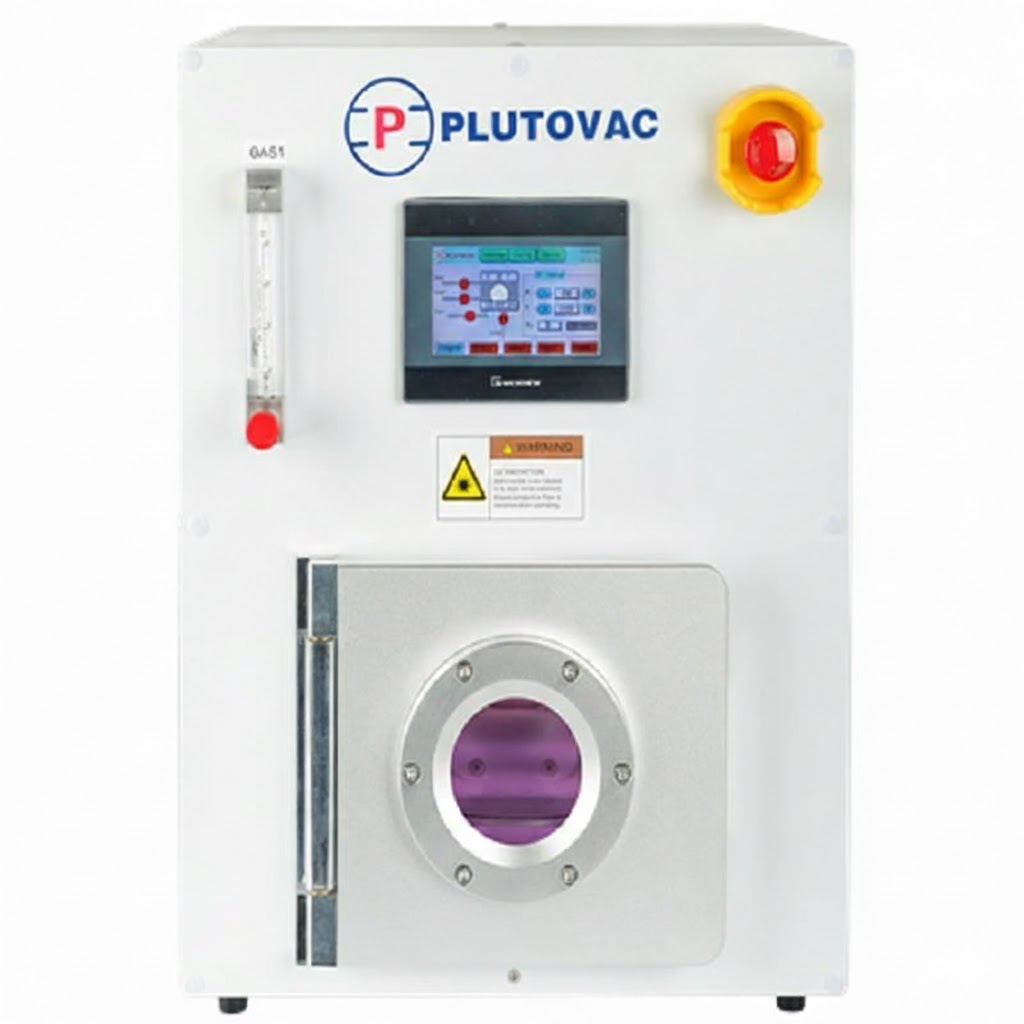
How Plasma Cleaning Works
A plasma cleaner uses ionized gas — plasma — to remove organic contaminants, oxides, and residues from a substrate surface at the molecular level. Unlike wet chemical cleaning, plasma cleaning is a dry process that leaves no solvent residue and can treat surfaces without physical contact.
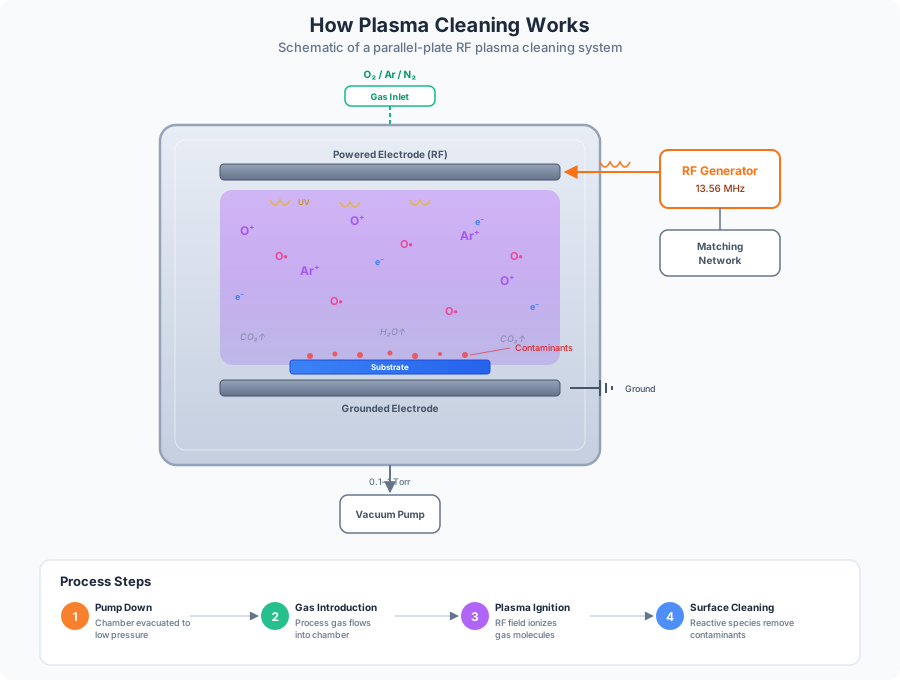
Here is the basic sequence of how plasma cleaning works:
- Vacuum creation. The sample is placed inside a sealed chamber, which is then pumped down to a low-pressure environment (typically 0.1–1 Torr).
- Gas introduction. A process gas — such as oxygen (O₂), argon (Ar), nitrogen (N₂), or a mixture — is introduced into the chamber at a controlled flow rate.
- Plasma ignition. An electromagnetic field (RF, DC, or microwave) is applied to the gas, stripping electrons from gas molecules and creating a plasma consisting of ions, free radicals, electrons, and UV photons.
- Surface interaction. Reactive species in the plasma interact with contaminants on the substrate surface. Organic materials are broken down into volatile byproducts (CO₂, H₂O) that are pumped away. Meanwhile, the energized species can also modify the surface energy and wettability of the substrate.
The result is a surface that is ultraclean, chemically activated, and ready for subsequent processing steps like bonding, coating, or wire bonding.
Key Cleaning Mechanisms
Plasma cleaning involves several simultaneous mechanisms. Understanding these helps you choose the right gas chemistry and process parameters.
Chemical Etching (Reactive Cleaning)
Reactive gas plasmas — most commonly oxygen — generate free radicals that chemically react with organic contaminants. For example, oxygen radicals break C–C and C–H bonds in hydrocarbon residues, converting them to CO₂ and H₂O. This mechanism is highly effective for removing photoresist residues, fingerprint oils, and organic thin films.
Physical Sputtering
When heavier inert gas ions (such as Ar⁺) strike the surface with sufficient kinetic energy, they physically knock off surface atoms and contaminant molecules. Sputtering is less selective than chemical etching but useful for removing inorganic contaminants and thin oxide layers.
UV Photodissociation
The UV radiation generated within the plasma can break chemical bonds in surface contaminants, making them more volatile and easier to remove. This mechanism works synergistically with chemical and physical processes.
In practice, most plasma cleaning processes use a combination of these mechanisms. A common approach is to use an O₂/Ar gas mixture, combining the chemical reactivity of oxygen with the physical bombardment of argon for thorough surface preparation.
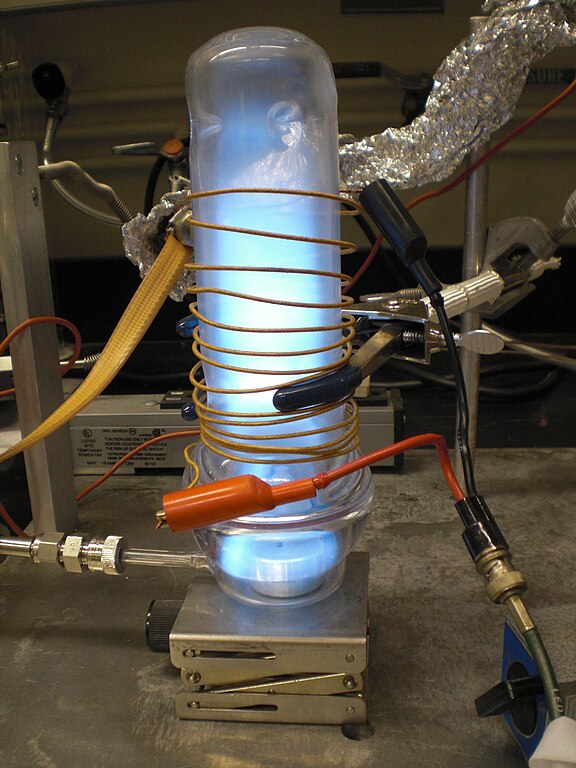
Types of Plasma Cleaners: A Technical Comparison
Plasma cleaners are generally categorized by their power source and electrode configuration. Each type has distinct characteristics that make it better suited for certain applications.
RF (Radio Frequency) Plasma Cleaners
RF plasma cleaners operate at 13.56 MHz (the ISM-standard frequency) and are the most widely used type in industrial and research settings.
How they work: An RF generator creates an oscillating electric field between electrodes (or a coil) inside the vacuum chamber. The oscillating field efficiently ionizes gas molecules, producing a dense, uniform plasma.
Advantages:
- Excellent plasma uniformity across large substrates
- Works with virtually all process gases, including reactive and inert types
- Can clean insulating materials without charge buildup
- High plasma density at relatively low pressures
Limitations:
- Higher equipment cost due to RF generator and impedance matching network
- Requires proper RF shielding to prevent electromagnetic interference
Best for: Semiconductor wafer cleaning, PCB surface preparation, medical device treatment, and research applications requiring precise control.
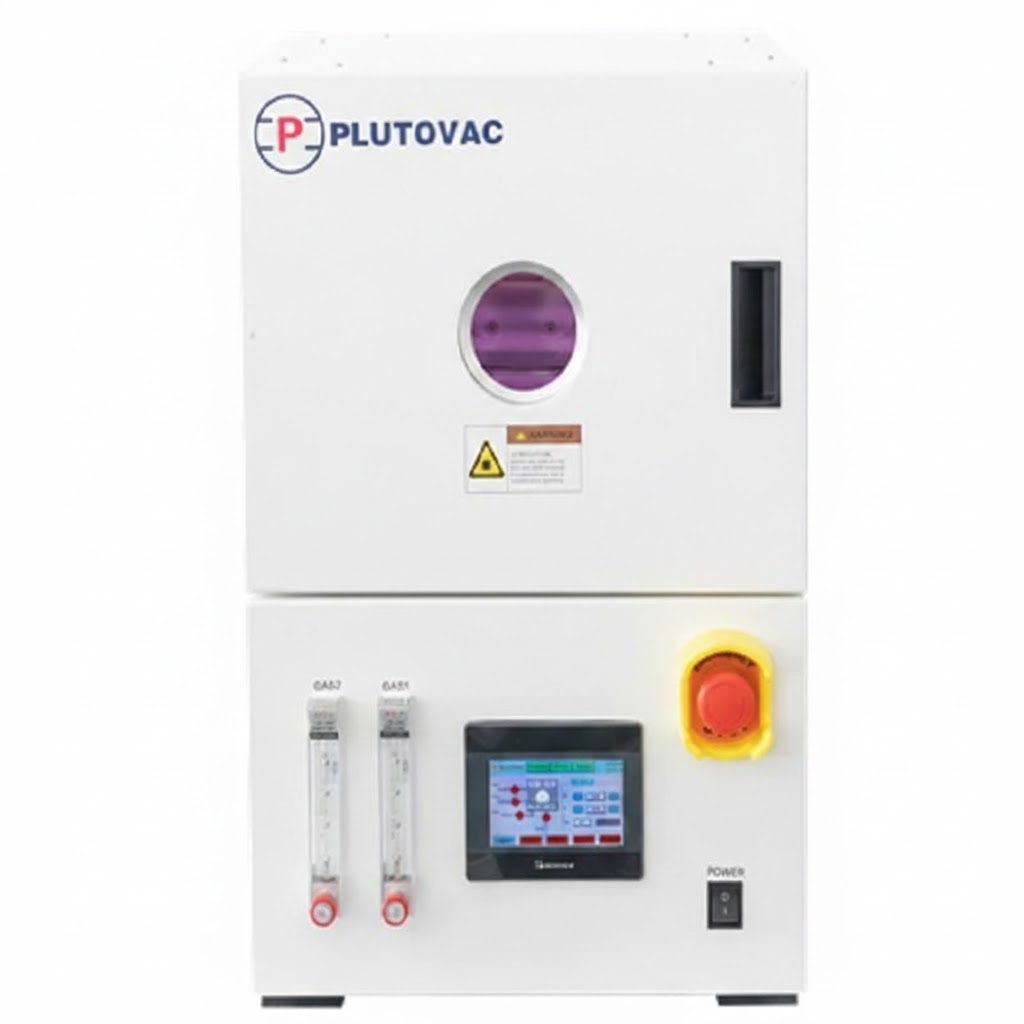
DC (Direct Current) Plasma Cleaners
DC plasma systems use a continuous voltage applied between two electrodes to sustain the plasma discharge.
How they work: A DC voltage (typically 300–1000 V) is applied between an anode and cathode inside the chamber. Gas molecules are ionized by electron impact in the resulting electric field.
Advantages:
- Simpler and less expensive design
- Straightforward power control
- Effective for conductive substrates
Limitations:
- Cannot reliably clean insulating substrates (charge accumulates on non-conductive surfaces, extinguishing the plasma)
- Less uniform plasma distribution compared to RF systems
- Generally lower plasma density
Best for: Metal surface cleaning, conductive material preparation, and cost-sensitive applications involving conductive substrates only.
Microwave Plasma Cleaners
Microwave systems use electromagnetic radiation at 2.45 GHz to generate plasma, often in a downstream or remote configuration.
How they work: Microwave energy is coupled into the process gas through a waveguide or cavity. In downstream configurations, the plasma is generated remotely and reactive species flow to the sample, reducing ion bombardment damage.
Advantages:
- Very high plasma density and radical concentration
- Downstream designs minimize physical damage to sensitive substrates
- Electrode-free design eliminates contamination from sputtered electrode material
- Effective at higher pressures than RF systems
Limitations:
- More complex and expensive equipment
- Limited to smaller chamber volumes in some designs
- Less directional ion bombardment (can be an advantage or disadvantage)
Best for: Cleaning of delicate or damage-sensitive substrates, III-V semiconductor processing, and applications requiring very high radical flux with minimal ion damage.
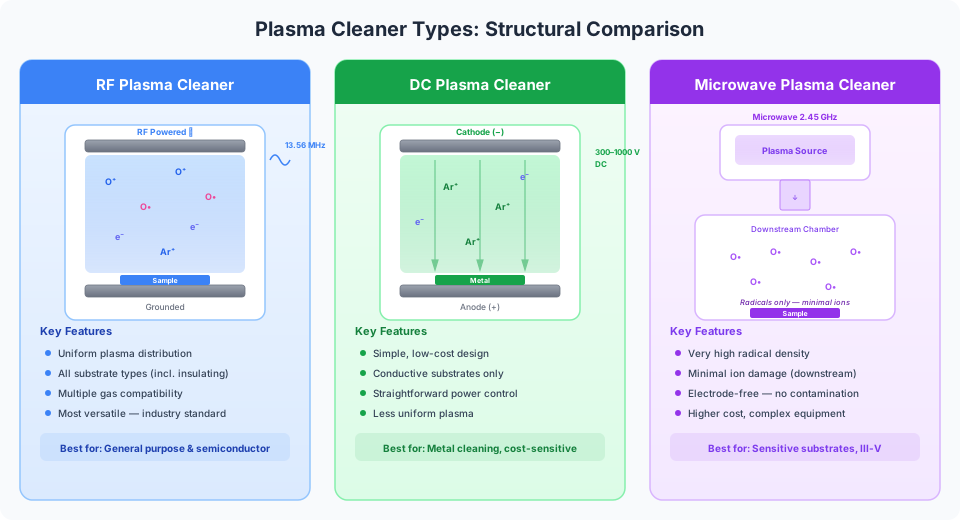
Comparison at a Glance
| Feature | RF Plasma | DC Plasma | Microwave Plasma |
|---|---|---|---|
| Operating frequency | 13.56 MHz | 0 (DC) | 2.45 GHz |
| Plasma density | High | Moderate | Very high |
| Substrate compatibility | Conductive & insulating | Conductive only | Conductive & insulating |
| Plasma uniformity | Excellent | Moderate | Good (downstream) |
| Ion damage risk | Moderate | Moderate–High | Low (downstream) |
| Equipment cost | Medium–High | Low–Medium | High |
| Typical use cases | General purpose, semiconductor | Metal cleaning | Sensitive substrates |
Plasma Cleaning vs. Other Surface Preparation Methods
To put plasma cleaning in context, here is how it compares to other common surface preparation techniques.
Plasma cleaning vs. wet chemical cleaning. Wet cleaning uses solvents or acid/base solutions and generates liquid waste requiring disposal. Plasma cleaning is a dry process with no chemical waste, making it more environmentally friendly and easier to integrate into cleanroom workflows.
Plasma cleaning vs. UV-ozone cleaning. UV-ozone systems use UV light to generate ozone, which oxidizes organic contaminants. Plasma cleaners are generally faster, more versatile (they can handle a wider range of contaminants), and offer better control over surface chemistry through gas selection.
Plasma cleaning vs. ultrasonic cleaning. Ultrasonic cleaning uses cavitation in a liquid bath to remove particles and contaminants. It is effective for particulate removal but less effective for molecular-level organic contamination. Plasma cleaning excels at removing molecular-level residues that ultrasonic methods cannot address.
Process Parameters That Matter
When operating a plasma cleaner, several parameters directly affect cleaning results:
- Gas type and flow rate. O₂ for organic removal, Ar for physical sputtering, N₂ or H₂ for specific chemical modifications. Flow rates typically range from 5–50 sccm depending on chamber size.
- RF power. Higher power increases plasma density and cleaning rate, but also increases the risk of substrate damage. Typical ranges are 50–300 W for bench-top systems.
- Pressure. Lower pressure increases ion mean free path and energy (more physical sputtering), while higher pressure increases radical density (more chemical etching). Typical operating range is 200–800 mTorr.
- Treatment time. Most cleaning processes take 1–10 minutes. Over-treatment can roughen or damage surfaces.
- Substrate temperature. Plasma exposure heats the substrate. Temperature-sensitive materials may require pulsed plasma or lower power settings.
Summary
Plasma cleaning is a versatile, dry, and environmentally friendly method for preparing surfaces at the molecular level. The choice between RF, DC, and microwave plasma cleaners depends on your substrate material, sensitivity requirements, throughput needs, and budget. For most general-purpose applications, RF plasma cleaners offer the best balance of performance, flexibility, and substrate compatibility.
Understanding these fundamentals will help you optimize your cleaning process and make more informed decisions when evaluating equipment — which we cover in detail in our plasma cleaner buying guide.
References
- Fridman, A. Plasma Chemistry. Cambridge University Press (2008). ISBN 978-0521847353.
- Tendero, C., et al. "Atmospheric pressure plasmas: A review." Spectrochimica Acta Part B, 61(1), 2–30 (2006). doi:10.1016/j.sab.2005.10.003
- Morent, R., et al. "Non-thermal plasma treatment of textiles." Surface and Coatings Technology, 202(14), 3427–3449 (2008). doi:10.1016/j.surfcoat.2007.12.027