Probe Station Procurement for NSF and DOE-Funded Projects: A Practical Guide
By NineScrolls Engineering · 2026-07-13 · 14 min read · Metrology & Testing
You have the award. The probe station your lab needs is picked out. Now comes the part that quietly derails more equipment purchases than any technical decision: buying it in a way your institution and your Federal sponsor will accept. This guide is about that second problem — how to buy compliantly under an NSF or DOE award — and it is a companion to our guide to choosing the right probe station, which covers how to choose the instrument itself.
The single most useful distinction to start from is this: an NSF or DOE research grant is a Federal assistance award, not a Federal procurement contract. When a Federal agency buys something for itself, it follows the Federal Acquisition Regulation (FAR). When your university spends assistance-award money to buy equipment for your lab, it does not run a FAR acquisition. Instead: Universities purchasing equipment under a Federal assistance award generally follow their documented institutional procurement procedures together with the applicable Uniform Guidance procurement standards in 2 CFR 200 — not the FAR procedures used by Federal agencies for their own contracts. Getting that framing right prevents most of the misunderstandings that follow, including the myth that a supplier must be a Federal contractor to be paid from your grant.
Last reviewed: 2026-07-13.
The compliance checklist, in order
Before any of the detail below, the sequence that keeps a purchase clean is short. Work it top to bottom:
- Award terms first. Read the award notice and its terms and conditions. They can impose requirements beyond 2 CFR 200 — prior approvals, participant restrictions, reporting — that override any general rule of thumb.
- Institutional thresholds next. Your institution adopts its own micro-purchase and simplified-acquisition thresholds — the micro-purchase figure is a Federal baseline your institution may set lower or, with the right certification or approval, higher, while the adopted simplified acquisition threshold may not exceed the FAR figure. Those adopted numbers — not the headline Federal figures — decide which method you must use. Call your sponsored-programs or purchasing office and ask for them in writing.
- Method. Match the purchase amount to the procurement method your institution's thresholds require (micro-purchase, simplified acquisition, or formal procurement), or to a documented noncompetitive exception if one genuinely applies.
- Time windows. Map every real clock: the award's period of performance, sponsor-specific conditions, internal requisition and purchase-order deadlines, quote validity, and the full production-plus-import-plus-delivery-plus-acceptance lead time.
- Vendor onboarding. Confirm what your institution needs from the supplier — vendor setup forms, tax documentation, banking details, insurance — early, so onboarding is not the thing that runs past a deadline.
The rest of this article expands each step, with three worked examples and the regulatory citations behind them.
The rules map: institution-adopted thresholds and the method they select
The Uniform Guidance procurement standards live in 2 CFR 200, Subpart D. They are not homogeneous, and it helps to know which section does what:
- §200.317 — States use their own procurement policies (subject to a short list of Federal requirements). This is why state-university buyers should confirm with their own procurement office how their institution is treated.
- §§200.318–200.327 — the standards universities and nonprofits center on, covering general standards, competition, methods, contract administration, and records.
- §200.320 — selects the procurement method (informal, formal, or noncompetitive) by transaction size.
- §200.324 — adds a required cost or price analysis for every transaction above the simplified acquisition threshold.
- §200.325 — requires the recipient to make procurement documents available for pre-procurement review upon the Federal agency's or pass-through entity's request when the procurement falls into the section's enumerated circumstances (for example, an above-SAT procurement awarded without competition or specifying a brand name) — it is not triggered by exceeding the SAT alone.
The headline Federal numbers are a starting point, not your operating rule — and the two thresholds behave differently. As of 2025-10-01 the FAR micro-purchase threshold (MPT) is $15,000, and that figure is a default baseline rather than a limit on recipients: your institution may adopt a lower MPT, may self-certify an MPT up to $50,000 annually under the §200.320(a)(1)(iv) conditions, and may adopt an MPT above $50,000 only with the approval of its cognizant agency for indirect costs under §200.320(a)(1)(v). The simplified acquisition threshold works the other way: an institution's adopted SAT may be lower than the FAR figure of $350,000 but may not exceed it. So a principal investigator's first step is not memorizing the Federal figures at $15,000 and $350,000 — it is checking which numbers their own institution has adopted, because those govern.
| Purchase amount | 2 CFR 200 default framework | Practical action |
|---|---|---|
| ≤ institution's adopted MPT | Micro-purchase | No competitive quotes required, but the institution must consider the price reasonable and document it |
| > MPT, ≤ institution's adopted SAT | Simplified acquisition | Price or rate quotations from an adequate number of qualified sources |
| > institution's adopted SAT | Formal procurement | Public notice + sealed bids or competitive proposals |
| Any amount, qualifying exception | Noncompetitive procurement | Must fit one of §200.320(c)'s enumerated circumstances, documented per institutional procedure |
Read the table as a default map, not a rulebook. Your institution's adopted thresholds shift the boundaries; your award terms can add conditions on top. When the two disagree, the stricter requirement usually wins — confirm with your procurement office.
Three worked examples
These are illustrative examples at three probe-station price points, walking through which method applies under the default Federal thresholds. In every case, your institution's adopted numbers — which may be lower — are what actually govern, so treat these as orientation, not a determination for your purchase.
Illustrative example 1 — a $12,000 manual station
At $12,000, a purchase sits at or below the default $15,000 micro-purchase threshold, so under the default framework it is a micro-purchase: no competitive quotes are required, but your institution still has to judge the price reasonable and document that judgment. The catch is the institution-first rule — if your university has adopted a lower MPT (institutions may set the number below the Federal default), this same $12,000 buy could land in simplified-acquisition territory and require quotes. Confirm your adopted MPT before assuming a single quote is enough.
Illustrative example 2 — a $120,000 semi-automatic station
At $120,000, the purchase is well above the default micro-purchase baseline and below the SAT ceiling under default thresholds — your institution's adopted numbers govern — so under the default framework it is a simplified acquisition: obtain price or rate quotations from an adequate number of qualified sources. For specialized instruments where few vendors can meet the technical requirement, "an adequate number" is judged in context — and if genuine competition is not available, that points toward a documented noncompetitive justification under the applicable §200.320(c) circumstance rather than a pretense of shopping. Document your market research either way.
Illustrative example 3 — a $400,000 automated or cryogenic system
At $400,000, the purchase exceeds the default $350,000 SAT, so under the default framework it moves into formal procurement — public notice with sealed bids or competitive proposals. Two more provisions become relevant above the SAT: §200.324 requires a cost or price analysis for the transaction, and §200.325 can bring pre-procurement review into play — not automatically on crossing the SAT, but when the procurement also falls into one of that section's enumerated circumstances (for example, an above-SAT buy awarded without competition or specifying a brand name) and the Federal agency or pass-through entity requests the documents. Start early; formal procurement and any pre-award review add calendar time. And again — if your institution adopted a lower SAT, the formal-procurement line arrives sooner than $350,000.
Noncompetitive procurement: when it is allowed, and why justifications fail
"Sole source" is the phrase everyone reaches for, but the Uniform Guidance is narrower and more specific. Under §200.320(c), noncompetitive procurement is permitted only when one of these circumstances applies:
- the aggregate amount does not exceed the micro-purchase threshold;
- the item or service can only be provided by a single source;
- a public exigency or emergency will not permit the delay of a competitive solicitation;
- the Federal agency or pass-through entity provides written approval in response to a written request; or
- competition is determined inadequate after a solicitation of several sources.
The common failure mode is arguing preference where the rule demands necessity. Brand preference, "the PI is used to this model," or "this one performs better" are usually not sufficient on their own. Note also that these are distinct circumstances, not one funnel: single source (§200.320(c)(2)) means the requirement can only be fulfilled by one source, while inadequate competition (§200.320(c)(5)) applies only after an actual solicitation of several sources comes back short — document the noncompetitive justification under the circumstance that actually applies. Where single source is the claim, a defensible justification argues from non-substitutable technical requirements: specific measurement range, positioning resolution, compatibility with an existing system, interfaces to instruments the lab already owns — supported by a genuine alternatives analysis explaining why other systems were considered and why they do not meet the requirement. The exact format, the approval levels, and the market-research expected are institution-specific, so follow your procurement office's template and process. No template or wording can promise approval; a well-documented technical case simply gives the reviewer what they need to say yes.
The realistic timeline (and the clocks that actually matter)
Equipment purchases slip because the calendar is planned around the wrong deadline. The one clock people over-weight is a fiscal boundary; the clocks that actually bind are these:
- Award period of performance — the end date on the award itself, after which costs generally are not allowable.
- Sponsor-specific award conditions — prior-approval or restriction clauses in your particular award.
- Internal institutional deadlines — requisition, encumbrance, purchase-order, and closeout cutoffs your university sets, which can fall well before an award end date. An institution may also set its own fiscal-year purchasing cutoff; treat that as an institutional variable to confirm, not a Federal rule.
- Quote validity windows — a budgetary quote does not hold its price forever.
- Lead time end to end — production, plus import and customs, plus delivery, plus installation and acceptance. For a built-to-order or imported instrument this is often the longest clock of all.
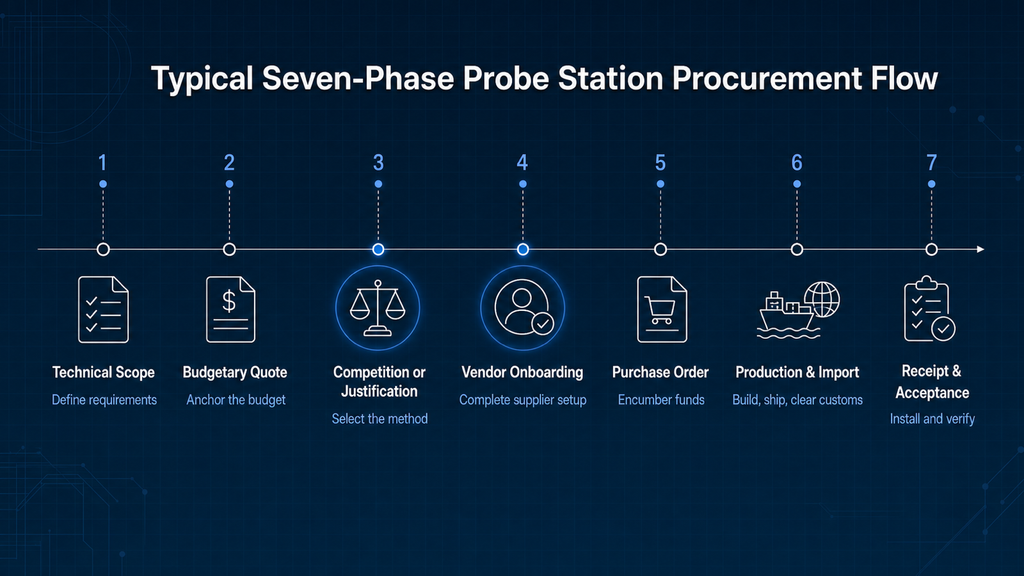
Two practical habits protect the schedule. Begin the technical scoping and budgetary-quote conversation months ahead of any deadline, and start vendor onboarding in parallel — not after the purchase order is approved — so supplier setup is never the item that runs late.
NSF and DOE: an award-specific overlay, not a static comparison
There is no single "NSF rule" or "DOE rule" for buying a probe station that sits apart from 2 CFR 200. The agencies add an overlay to the Uniform Guidance, and that overlay is award-specific. The dependable approach: Start with 2 CFR 200, then check the award notice, current agency supplements, program solicitation, and institutional policy. NSF recipients should review the applicable PAPPG and supplemental notices; DOE awards may carry additional provisions under 2 CFR 910 and the specific award terms.
For NSF, the governing policy document is the Proposal & Award Policies & Procedures Guide. The current version is PAPPG (NSF 24-1), and it explicitly defers to the Uniform Guidance where they conflict — in any inconsistency between the PAPPG and 2 CFR (including part 200), 2 CFR controls. NSF has also issued supplemental policy notices — NSF 26-200, applying to financial assistance awarded on or after December 8, 2025, and NSF 26-202, applying to financial assistance awarded on or after January 22, 2026 — which is exactly why the award notice and current supplements must be checked rather than assumed. For DOE, awards are administered under the Department's financial-assistance framework in 2 CFR 910 together with the specific award terms; where an equipment purchase touches a DOE-specific provision, confirm it against your award document rather than a general summary. Beyond that, the honest guidance is a single reminder: the terms of your particular award, read alongside 2 CFR 200, are the authority — not a generic agency comparison.
Vendor readiness and what a supplier can (and cannot) claim
Universities onboard new suppliers through their own vendor-setup process, and the requirements vary by institution. A commercial equipment supplier is commonly requested to provide items such as a completed vendor-registration form, a W-9 (for a US entity), quotes stated in US dollars, and a certificate of insurance — but these are things that may be requested under a given institution's policy, not universal legal requirements of every Federal-grant purchase.
On the specific question of SAM.gov: NineScrolls LLC maintains an active SAM.gov registration and UEI C4BFCTH5L5D1. That is a useful convenience for institutions that prefer to transact with SAM-registered vendors, and nothing more. To be precise about what it does and does not mean: a university's vendor-onboarding requirements are institution-specific, and a commercial equipment supplier is not universally required to register in SAM.gov merely because the purchase is charged to a Federal grant. Treat the registration as a bonus fact that can smooth onboarding, not as a compliance requirement we are asserting on your behalf.
Import and quoting boundaries: confirm the terms line by line
Many analytical instruments are built outside the United States, so how a quote handles import materially changes what you pay and who is responsible. "Delivered," "DAP," "DDP," and "ex-works" are not interchangeable, and the difference decides who is the importer of record, who clears customs, and who bears duty. Confirm the incoterm on each line item rather than assuming the headline number is landed cost. Our buyer guide covers this in more depth in its section on import duties and delivery terms.
For SEMISHARE probe stations quoted through NineScrolls, the quotation identifies the applicable delivery term, import responsibilities, and any separately stated logistics charges for the quoted configuration — so responsibility for duty and delivery is visible on the quote rather than surfacing as a surprise at customs.
Where NineScrolls fits
For a US or international research lab, the harder part of a SEMISHARE probe station purchase has usually been the procurement path — obtaining a compliant, comparable quote and arranging import — rather than the instrument. NineScrolls provides a US-based path for configuration discussions, quoting, import coordination, and post-sale support, with installation, calibration, training, warranty handling, and on-site service scope confirmed for each quoted configuration. For the selection side of the decision, our wafer probe stations hub walks through automation level, temperature, signal type, sample size, and positioning.
To start a compliant, fully specified quote for your NSF- or DOE-funded project, request a quote and tell us your award and institutional constraints — we will build the quotation to line up with how your procurement office needs to see it.
Further reading
This article is the "how to buy compliantly" companion to our selection guide. If you have not yet settled on the configuration, read How to Choose a Wafer Probe Station for Your University Research Lab first, then return here for the procurement path.
References
- Micro-purchase and simplified acquisition threshold changes (MPT $15,000; SAT $350,000; effective October 1, 2025) — acquisition.gov/threshold-changes. Accessed 2026-07-13.
- 2 CFR 200 Uniform Guidance, Subpart D — Procurement Standards (§§ 200.317–200.327) — ecfr.gov, 2 CFR 200 Subpart D. Accessed 2026-07-13.
- 2 CFR 200.320, Procurement methods (informal, formal, and noncompetitive; micro-purchase self-certification up to $50,000 at (a)(1)(iv); cognizant-agency approval for micro-purchase thresholds above $50,000 at (a)(1)(v); noncompetitive circumstances at (c)) — ecfr.gov, 2 CFR 200.320. Accessed 2026-07-13.
- 2 CFR 200.324, Contract cost and price (cost or price analysis for transactions above the simplified acquisition threshold) — ecfr.gov, 2 CFR 200.324. Accessed 2026-07-13.
- 2 CFR 200.325, Federal agency or pass-through entity review (pre-procurement review, upon request, when an enumerated condition applies—for example, an above-SAT procurement expected to be noncompetitive, receive only one bid, or specify a brand-name product) — ecfr.gov, 2 CFR 200.325. Accessed 2026-07-13.
- NSF Proposal & Award Policies & Procedures Guide, PAPPG (NSF 24-1) — which defers to 2 CFR (including part 200) in the event of any inconsistency — nsf.gov/policies/pappg/24-1. Accessed 2026-07-13.
- NSF Supplemental Policy Notice NSF 26-200, modifying PAPPG (NSF 24-1) — applies to all financial assistance awarded on or after December 8, 2025 — listed on nsf.gov/policies/pappg. Accessed 2026-07-13.
- NSF Supplemental Policy Notice NSF 26-202, modifying PAPPG (NSF 24-1) — applies to all financial assistance awarded on or after January 22, 2026 — listed on nsf.gov/policies/pappg. Accessed 2026-07-13.
- 2 CFR 910, Department of Energy financial assistance (DOE's implementation of the Uniform Guidance) — ecfr.gov, 2 CFR 910. Accessed 2026-07-13.
Last reviewed: 2026-07-13.