Cryogenic Probe Station Buyer's Guide: Architectures, Specifications, and an Acceptance-Ready RFQ
By NineScrolls Engineering · 2026-07-13 · 12 min read · Metrology & Testing
A cryogenic probe station is bought on its numbers — a target temperature, a vibration figure, a vacuum level, a cooldown time — and those numbers are where the trouble hides. Two systems can quote the same headline temperature and behave completely differently under a real measurement, because the conditions behind the number were never stated. This guide is about reading those specifications the way a metrologist reads them, comparing cooling architectures on the same axes, and writing a request for quotation that makes performance verifiable at delivery rather than aspirational in a brochure.
The application page explains when cryogenic probing is appropriate. This guide explains how to compare cooling architectures, interpret temperature and vibration specifications, and prepare an acceptance-ready RFQ. If you have not yet decided whether your work actually needs low temperature at all — whether a thermal chuck would do — start with the companion cryogenic probing application page, then come back here to compare systems.
Last reviewed: 2026-07-13.
TL;DR: the spec checklist, in order
Before the detail, the short sequence that keeps a cryogenic-station comparison honest. Work it top to bottom, and make every vendor answer each line under the same stated conditions:
- Target temperature. Decide the temperature your physics actually requires, then treat every quoted temperature as a claim that must state its test conditions — not a property of the box.
- Cooling architecture. Match the temperature and duty cycle to one of the three architectures below — nitrogen-cooled, closed-cycle, or helium — each with different facility and operating consequences.
- Vibration budget. Know how much mechanical motion your measurement tolerates, and demand vibration figures with a stated location, axis, and cooler operating state so they are comparable between vendors.
- Signal types. Count your DC, RF, and optical channels now; every added cable and feedthrough is both a signal path and a heat path.
- Sample size and mounting. Fix the wafer or die size and the chuck construction, because the sample and its mount are part of the thermal load the base temperature is measured against.
- Operating cost. Estimate cryogen use, utilities, maintenance, and staff time per run before you compare purchase prices — operating costs can materially change the purchase-price ranking.
The three cooling architectures
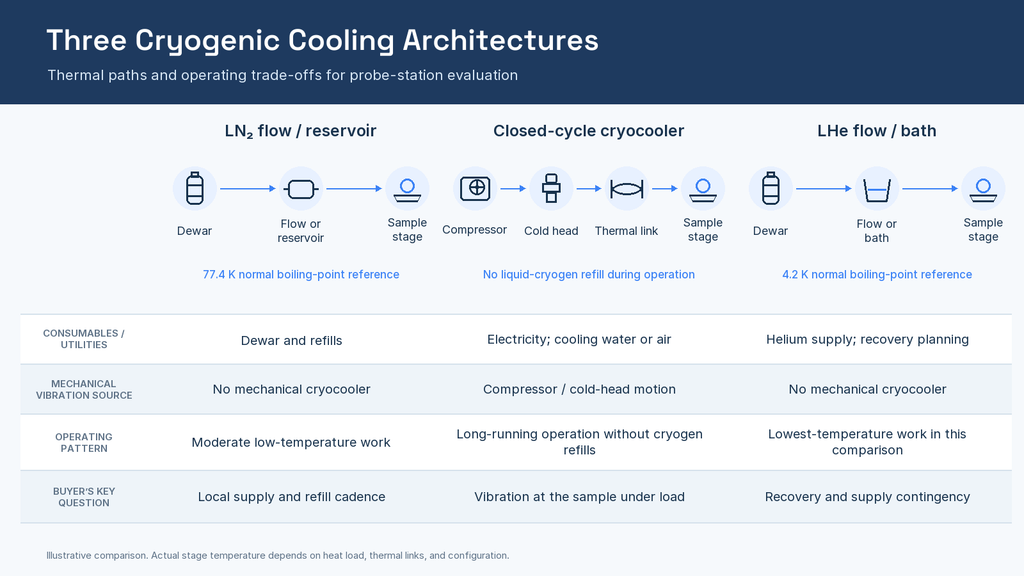
Cryogenic probe stations reach low temperature in one of three broad ways. The categories are not ranked — each is the right answer for a different combination of target temperature, duty cycle, and facility. The useful comparison is always on the same axes: the cooling medium, the typical use pattern, and the facility needs.
LN₂-cooled flow or reservoir systems
These systems cool with liquid nitrogen, either flowed through the stage or held in a reservoir. Liquid nitrogen has a normal boiling point of 77.4 K at atmospheric pressure, which sets the category's orientation — this is the family for research whose physics appears at moderate low temperature rather than the deepest cold. For many institutional users it is the most accessible of the cryogens — confirm local supply and pricing with your own facility. The facility burden is a nitrogen dewar and periodic refills; the trade is that the coldest phenomena remain out of reach. Note that 77.4 K is the boiling point of the cryogen at atmospheric pressure, not a stage temperature you can assume; where a real sample and wiring sit is a separate question, addressed below.
Closed-cycle cryocooler systems
A closed-cycle cryocooler cools mechanically, recirculating compressed helium gas through a cold head with no need to refill a liquid cryogen — hence the common description "cryogen-free." Because there is no liquid cryogen to replenish during operation — the system runs on electricity — this is the architecture suited to continuous, long-running use and to labs that prefer not to manage recurring cryogen deliveries. Closed-cycle systems are often described as 10 K-class as a category orientation; that phrase is a rough family label, and the actual stage temperature depends on heat load, thermal links, and configuration rather than on the label. The cost of the convenience is a compressor, cooling water or air, an electrical load, and — as the vibration section explains — mechanical motion that must be managed.
LHe flow or bath systems
Where the science demands the lowest temperatures in this comparison, systems cool with liquid helium, whose normal boiling point is 4.2 K at atmospheric pressure — the lowest boiling point of the three cooling media (4.2 K against nitrogen's 77.4 K), which is why the LHe family serves the lowest-temperature work here [3]. Again, 4.2 K is the boiling point of the cryogen and a category orientation, not a promised stage temperature. The operating burden centers on the helium itself: helium is a traded commodity whose production and supply the US Geological Survey tracks in its annual commodity statistics [4], so a serious helium plan settles recovery or a supply contingency before the purchase, not after. Choose this family when the measurement genuinely requires it, not by default.
Base temperature under defined load — the spine of the comparison
The single most misread number on a cryogenic quote is "base temperature." A base temperature is only meaningful with the load it was measured against, and it refers to a specific place. Four locations get casually conflated, and a rigorous comparison keeps them separate:
| Location | What it is | Why the difference matters |
|---|---|---|
| Cryocooler cold head | The coldest point of the cooling engine itself. | The most optimistic number, furthest from your device; useful for the cooler, not for your measurement. |
| Sample stage / chuck | The stage or chuck the sample is mounted on. | Closer to reality, but still not the sample — thermal resistance across the mount adds a gap. |
| Temperature-sensor location | Wherever the sensor that reports the number is physically placed. | A reading is only as representative as the sensor's position; a sensor on the stage is not reading the device. |
| Actual sample or device | The temperature the device under test actually reaches. | The quantity your physics actually depends on. In practice, acceptance criteria specify a named sensor location and its known relationship to the device temperature, rather than the device temperature directly. |
The gaps between these four grow with every heat path you add. That is why base temperature must always be quoted under defined load. A number measured on a bare, unwired stage is not the number you will see with probes landed, cables run, and a sample mounted. The RFQ has to force the vendor to state the conditions behind any temperature claim:
- the number and type of probes in contact, and whether they are thermally anchored;
- the count of DC and RF cables and vacuum feedthroughs, each of which conducts heat inward;
- the sample itself and how it is mounted, since the sample and mount are part of the load;
- any additional loads that apply to your work — optical illumination through a window, an applied magnetic field, or continuous biasing;
- the steady-state criterion (how long the reading must hold and within what band) and the sensor location the number is read from.
The distinctions here are not pedantry. NIST's modeling of the transient behavior of a pulse-tube cryocooler separates exactly these ideas — the no-load condition, the effect of added thermal mass, the net cooling capacity as a function of time, and the resulting cooldown time [1]. A quote that gives one temperature with none of that context has told you the least useful version of the truth.
Vibration: compare metrics, not adjectives
"Low vibration" on a datasheet means nothing on its own. Mechanical coolers — closed-cycle systems in particular — introduce vibration by the nature of how they move gas, and that motion couples into the probe-to-pad contact where your measurement happens. The engineering question is never whether a cooler vibrates; it is how much motion reaches the sample, and whether the isolation scheme that reduces it does so without breaking the thermal path. Isolation always involves a trade-off between mechanical decoupling and thermal contact, so no single isolation approach is universally best — the right one depends on the system.
The point is well illustrated at the extreme: the cryocooler on the James Webb Space Telescope treats low vibration as one of its hardest requirements, because motion would jitter the optics and blur the image, and it manages that motion through finely balanced opposed pistons rather than by assuming a generic damper solves it [2]. Your bench is not a space telescope, but the discipline transfers: vibration is a managed quantity with a stated method, not a checkbox.
To make two vibration figures comparable, insist that each one states:
- Measurement location — cold head, stage, chuck, or probe tip; these differ by large factors.
- Axis — X, Y, and Z separately, not a single lumped value.
- Metric — RMS, peak, or peak-to-peak, since they are not interchangeable.
- Bandwidth — the frequency range the measurement covers.
- Cooler operating state — was the number taken with the cryocooler running, or with it off?
- Evidence under running conditions — demonstrated landing stability or measurement-noise data with the cooler running, which is the state you will actually work in.
Vacuum and interfaces as evaluation dimensions
The application page covers why cryogenic stations run under vacuum; this guide treats vacuum and the sample interfaces as things to compare and specify, because they shape day-to-day usability as much as the temperature does. Ask each vendor to describe, in operational terms:
- Pump-down and cooldown sequence and times. The realistic clock from a warm, vented chamber to a stable measurement — and back — sets your daily throughput.
- Where and when the vacuum figure is measured. A pressure quoted at the pump is not the pressure at the sample; ask for the gauge location and whether the figure is at room temperature or cold.
- Window, probe-arm, and feedthrough counts. How many optical windows, probe arms, and DC/RF feedthroughs the platform supports, and what adding one costs in heat load.
- Sample-exchange and warm-up workflow. How a sample is swapped, how long a warm-up-and-recool cycle takes, and whether a load-lock shortens it.
- Condensation and frost handling. What happens on an imperfect pump-down or a vacuum excursion, and the recovery procedure when frost forms.
Total cost of ownership: a framework, not a price
Purchase price is one component of a cryogenic station's cost. Much of the rest accrues over years, and it varies enough between institutions that no dollar figure would travel — so treat the following as a framework to fill in with your own numbers rather than a quote:
- Cryogen logistics. Storage, refill cadence, venting, and the safety training and handling procedures your institution requires for nitrogen or helium.
- Helium supply risk. For helium systems, two questions to answer with your own facility: what would recovery cost, and is it feasible in your building? And how exposed is your program if helium supply or pricing shifts? USGS commodity statistics are a neutral starting point for current supply context [4].
- Utilities and facility. Compressor and chiller power, cooling water or air, floor space, and any vibration-sensitive siting requirements.
- Maintenance and service. Planned maintenance intervals, the realistic cost and duration of unplanned downtime, and the vendor's service response time and geography.
- Staff time. Runs per week multiplied by cooldown-and-warm-up time multiplied by the loaded cost of the people running them — a line item that can rival any other on this list.
Populate this framework for each shortlisted system with your institution's actual figures; the resulting ranking may differ from the purchase-price ranking.
The acceptance-ready RFQ checklist
Everything above converges on one deliverable: a request for quotation written in acceptance criteria — conditions you can verify at delivery — rather than adjectives. For each item, ask the vendor to commit to a value and the method by which it will be demonstrated on your system:
- Target stage temperature under a defined load — stated with the probe, cable, feedthrough, sample, and any optical or magnetic loads that define that load.
- Stabilization time and allowed fluctuation — how long to reach steady state and the temperature band it must hold within, at a named sensor location.
- Cooldown and warm-up conditions — the times and the starting and ending states they assume.
- Vibration metrics and measurement method — location, axis, metric, bandwidth, and cooler operating state, per the vibration section.
- Probe, cable, and feedthrough counts — the DC, RF, and optical channel counts the configuration provides.
- Sample size and chuck construction — the wafer or die sizes supported and how the chuck is built.
- Vacuum, optical, and magnetic options — the achievable vacuum with its measurement conditions, plus window and magnet options if your roadmap needs them.
- Utilities and facility requirements — power, cooling, cryogen, and siting the system depends on.
- Installation, training, and service scope — itemized, so the quotation shows what is and is not included.
- Receipt and acceptance-test responsibility — who runs the acceptance test, against which criteria, and what evidence is delivered as the record.
Frame these as acceptance criteria to be demonstrated, and both sides know what "working" means before the purchase order is issued.
Where NineScrolls fits
For a research lab in the US or abroad, the harder part of acquiring a SEMISHARE probe station is usually the procurement and support path — a comparable, fully specified quotation and coordinated import — rather than the instrument. NineScrolls provides a US-based path for configuration discussions, quoting against your acceptance criteria, import coordination, and post-sale installation, training, and service scope confirmed for each quoted configuration. For the broader selection decision across automation level, sample size, and signal type, our wafer probe stations hub walks through the full framework.
To start a fully specified quote written around the acceptance criteria your lab needs to verify, request a quote and tell us your target temperature, sample size, and signal types.
Further reading
This buyer's guide is a companion to our university-lab selection guide. If you are still choosing automation level, sample size, and signal type, read How to Choose a Wafer Probe Station for Your University Research Lab first, then return here for the cryogenic-specific comparison.
References
- NIST, "A Model for the Transient Behavior of a Pulse Tube Cryocooler" — separates no-load temperature, added thermal mass, net cooling capacity, and cooldown time — nist.gov/publications/model-transient-behavior-pulse-tube-cryocooler. Accessed 2026-07-13.
- NASA, James Webb Space Telescope — Cryocooler (vibration management via balanced opposed pistons) — science.nasa.gov/mission/webb/cryocooler. Accessed 2026-07-13.
- NIST, "About Cryogenics" — normal boiling points of common cryogenic fluids at atmospheric pressure (liquid nitrogen 77.4 K; liquid helium 4.2 K) — nist.gov, About Cryogenics. Accessed 2026-07-13.
- USGS, Helium and Rare Gases Statistics and Information — annual Mineral Commodity Summaries and production/supply statistics for helium — usgs.gov, Helium Statistics and Information. Accessed 2026-07-13.
Last reviewed: 2026-07-13.